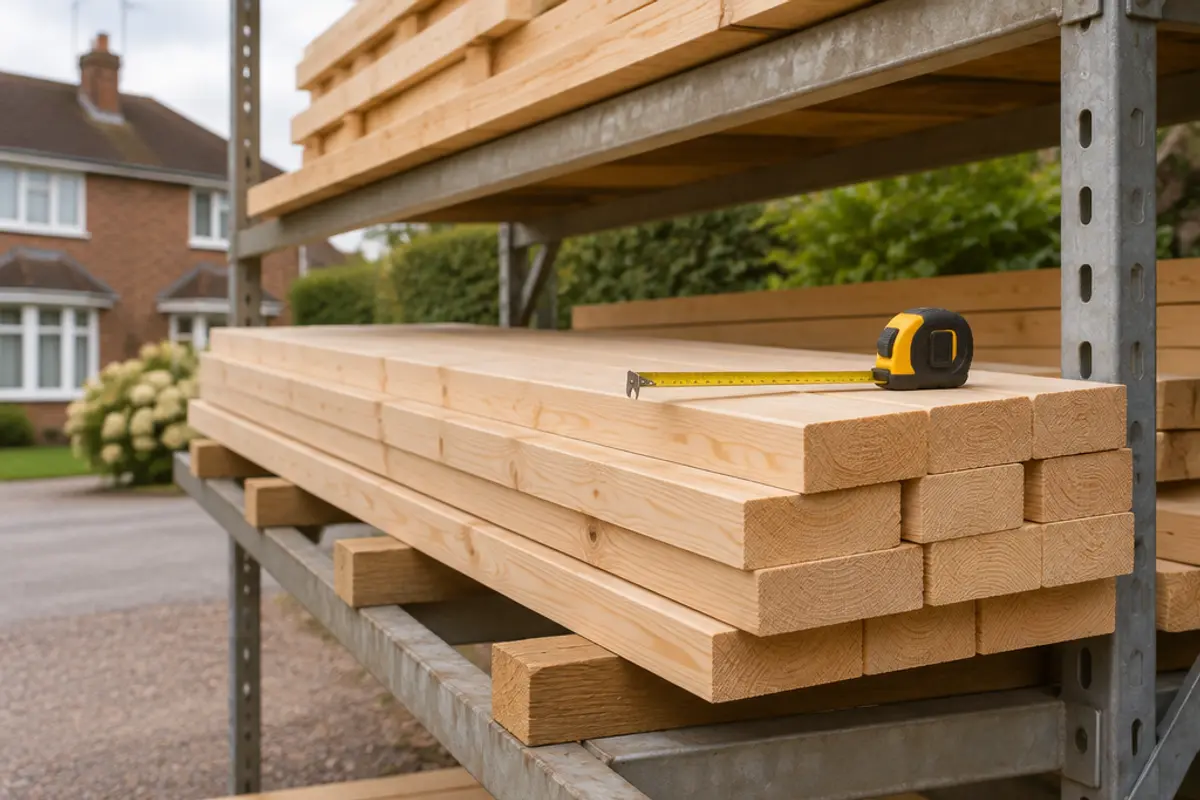
How to use the timber calculator
- Under What do you need? pick a stud wall, metres of timber into lengths to buy, or an area of boards into lengths to buy.
- For a stud wall, type in the Wall length and Wall height (floor to ceiling), then pick the Stud spacing: 400 mm or 600 mm centres.
- Pick your Timber size (CLS or regularised) and say how many Doors or windows are in the wall, how many Rows of noggins you want, and whether you need a double head plate.
- For lengths, type in the Total length of timber needed. For boards, type in the Area to cover, the Board width and the Gap between boards.
- If any piece must be one unjointed length, enter it under Longest single piece you need.
- Leave the waste at its starting figure, read the lengths to buy, then tap Add to shopping list to keep them or Share link to send them to your merchant.
Why use this calculator
It buys in real lengths. Merchants sell timber in standard lengths of 2.4, 3.0, 3.6, 4.2 and 4.8 m. The calculator tries each length and picks the one that leaves the least spare.
It works from the actual size of the timber. A CLS 50 × 75 is really 38 × 63 mm, and a regularised 47 × 100 is 45 × 95. The stud length and the volume come from the size you will actually hold.
It builds the whole stud wall: studs, head and sole plates, noggins, extra studs round each opening, and the cut length of each stud.
It shows its working. Under How we worked it out you can see every step with your own numbers.
How we worked it out
Your numbers, step by step. This updates as you change the calculator.
- Studs along the wall = length ÷ spacing + 1 = 4 m ÷ 0.4 m + 1 = 11
- Add 2 extra studs for each of 1 opening: 11 + 2 = 13 studs in the wall
- Add 5% spare: 13 × 1.05 = 13.65, round up to 14 studs
- Using 50 x 75 mm timber (actual 38 x 63 mm). Stud length = wall height − the plates = 2.4 m − 2 × 0.038 m = 2.324 m
- Plates: 1 head plate + 1 sole plate, each 4 m long = 8 m
- Noggins = 1 row × 10 gaps between studs = 10, plus 5% spare = 11 noggins, each 0.362 m (spacing − stud width)
- Studs: 14 × 2.324 m. A 2.4 m length gives 1 stud, so buy 14 × 2.4 m
- Plates: 2 runs of 4 m, so buy 2 × 4.2 m
- Noggins: 11 × 0.362 m. A 4.2 m length gives 11, so buy 1 × 4.2 m
- Total timber to buy = 46.2 m (17 lengths), which is 0.111 m³ at 38 x 63 mm
The formula
For a stud wall, the calculator counts each part, then works out which standard lengths to buy.
- Studs along the wall: wall length ÷ spacing, rounded up, plus 1. A 4 m wall at 400 mm centres is 10 + 1 = 11. We add 2 for each door or window, so 13 with one opening, then your spare percentage: 13 × 1.05 = 13.65, so 14.
- Stud length: wall height minus the plates. Each plate is as thick as the timber, with one sole plate and one or two head plates. For 2.4 m with CLS 50 × 75 (38 × 63 mm) that is 2.4 − 2 × 0.038 = 2.324 m.
- Plates: one sole plate and one head plate (or two), each as long as the wall.
- Noggins: rows × the gaps between studs, plus spare. Each noggin is the spacing less the stud width, so 400 − 38 = 362 mm.
- Lengths to buy: for each standard length, how many pieces you can cut and how many lengths that needs. We pick the one that buys the fewest metres.
- Boards to lengths: area ÷ (board width + gap), plus waste.
- Volume: metres bought × thickness × width.
For the default wall that comes to 14 studs from 2.4 m lengths, plates from 2 × 4.2 m, 11 noggins from one 4.2 m length, and 46.2 m of timber in all, which is 0.111 m³.
What we assume
- Sizes are CLS 50 × 75, 50 × 100 and 50 × 150 mm (actual 38 × 63, 38 × 89 and 38 × 140 mm), and regularised 47 × 75, 47 × 100 and 47 × 150 mm (actual 45 × 70, 45 × 95 and 45 × 145 mm). We always work from the actual size.
- Standard lengths are 2.4, 3.0, 3.6, 4.2 and 4.8 m. If your wall is longer than 4.8 m we use full lengths plus a shorter piece and warn you the plates have joints.
- Lintels and the cutting-out of the sole plate under a door are not included.
- The double head plate setting adds a plate. It does not check that a wall is safe to load.
Tips
- Plasterboard is 1,200 mm wide, so board edges land on a stud at both 400 mm and 600 mm centres. Work out the sheets with the plasterboard calculator.
- Check what your merchant stocks. Not every size comes in every length. CLS often comes in 2.4, 3.0 and 4.8 m, and 3.6 and 4.2 m lengths are mainly in the 47 mm sizes.
- Short pieces like noggins come out of one long length. The calculator picks the length that gives the fewest metres bought.
- Lintels are not included, and the plates under a door opening are cut out after the wall is up. For a load-bearing wall, ask a structural engineer or building control before you build.
- Joist and beam sizes and spans are not worked out here. They depend on the timber grade, the spacing and the load, so use the timber maker's span tables or ask a structural engineer.
- Buying decking boards? The decking calculator works out the boards, joists and fixings in one go.
 Plasterboard calculator
 Decking calculator
 Fence calculator
 Stair calculator
 Roof pitch calculator
 Project shopping list