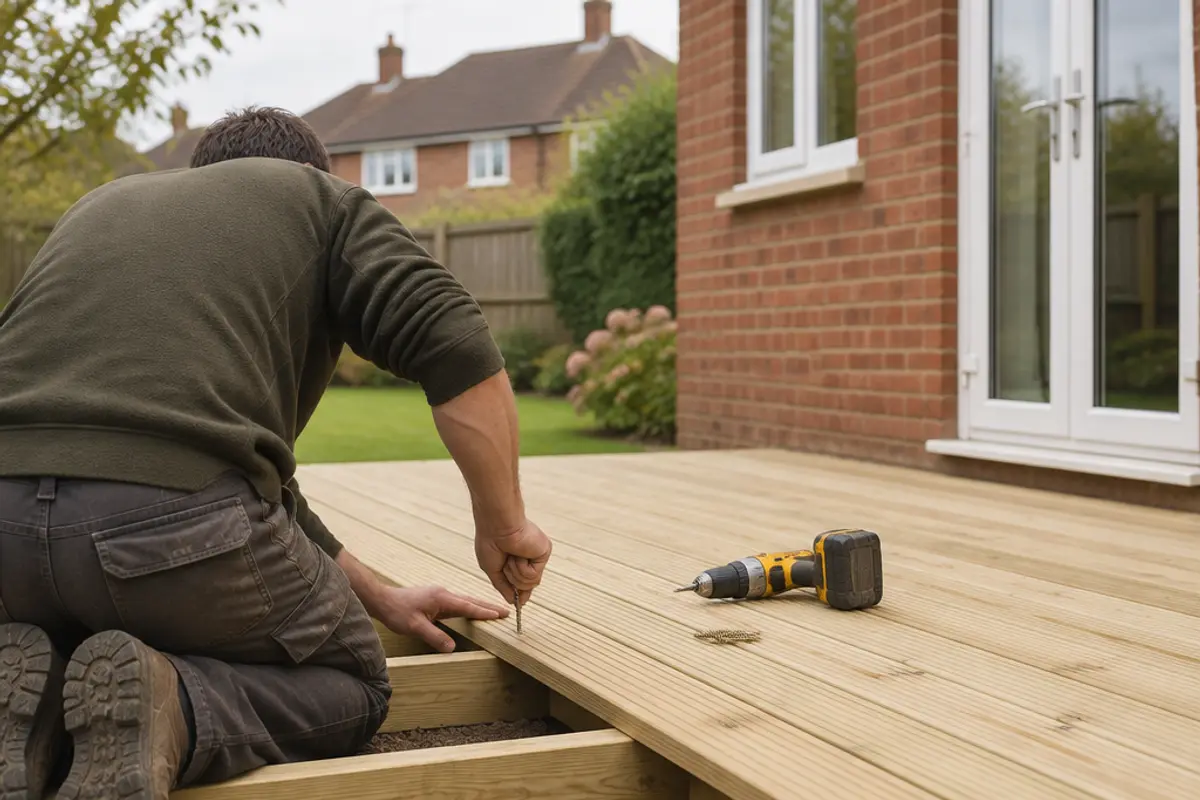
How to use the decking calculator
- Enter the Deck length and Deck width. Pick which way the boards run under Boards run along the. The joists go the other way, at right angles to the boards.
- Choose your Board size and Board length. The common UK boards are 144 mm or 140 mm wide and 28 mm thick, or 120 mm wide and 25 mm thick.
- Set the Gap between boards. 5 to 8 mm is usual. It lets water drain and the boards swell.
- Pick the Joist size and the Joist spacing (centre to centre). Stay at 400 mm unless the board maker says otherwise.
- Leave Extra for cuts and mistakes at 10%, or raise it to 15% if the boards go diagonally.
- Check the joist span warning, then tap Add to shopping list to keep the result or Share link to send it to your timber merchant.
Why use this calculator
It does the whole frame in one go. You get boards, joist timber and screws together, not just a board count.
It tells you which board length wastes least. A 4 m run wastes a lot of a 2.4 m board but very little of a 3.6 m one, so the calculator compares the lengths for you.
It checks the joist span. If your joists are longer than a 150 × 50 mm or 100 × 50 mm joist can carry at your spacing, it warns you before you buy.
It shows its working. Under How we worked it out you can see every step with your own numbers.
How we worked it out
Your numbers, step by step. This updates as you change the calculator.
- Each board plus its gap covers 0.144 m + 0.005 m = 0.149 m of the deck.
- Rows of boards = (3 m + gap) ÷ 0.149 m = 21 rows, each 4 m long.
- With 2.4 m boards each row needs 1 whole board plus an end piece of 1.6 m per row (one 2.4 m board gives 1 end piece): 42 boards.
- Add 10% for waste: 42 × 1.1 = 47 boards.
- Board length comparison: 2.4 m: 47 boards (112.8 m); 3.6 m: 27 boards (97.2 m); 4.8 m: 24 boards (115.2 m).
- Joists = 4 m ÷ 0.4 m + 1 = 11 joists, each 3 m long (33 m in total).
- Screws = 21 rows × 11 joists × 2 per board per joist = 462; add 10% = 509 screws.
The formula
Each board and its gap covers a strip of the deck. The number of rows is the width the boards are spread across, divided by the board width plus the gap, rounded up.
Rows = (width + gap) ÷ (board width + gap)
Each row is as long as the deck. Whole boards fill the row, and the end piece comes from a board that is cut. One cut board can give end pieces for more than one row if the offcut is long enough. The board count then has your extra percentage added and is rounded up.
- Joists: deck length ÷ joist spacing, rounded up, plus 1 for the far end. Each joist is as long as the width of the deck.
- Joist timber to buy: the stock length (2.4, 3.0, 3.6, 4.2 or 4.8 m) that uses the least timber, cutting more than one joist from a length where they fit.
- Screws: rows × joists × 2, plus your extra percentage.
- Board length comparison: the same sum for each board length of 2.4 m and longer. The “least-waste” length buys the fewest metres of board.
For a 4 m by 3 m deck with boards along the 4 m side, 144 mm boards, a 5 mm gap and 10% extra, that is 21 rows, 11 joists each 3 m long and 509 screws. A 2.4 m board needs 47 boards. A 3.6 m board needs 27, which is less timber.
What we assume
- Common boards are 144 × 28 mm, 140 × 28 mm and 120 × 25 mm. The usual gap is 5 to 8 mm.
- Board lengths are the ones we found in stock: 1.2, 2.4, 3.6 and 4.8 m. Joist timber is sold in 2.4 to 4.8 m lengths in 0.6 m steps, but stock varies by size and treatment, so check with your merchant.
- Joists are at 400 mm centres as standard. This is the maximum for 28 mm softwood boards. 32 mm hardwood boards can go to 600 mm.
- Joist spans are for C16 timber, the minimum strength class (C24 is recommended), on a domestic deck. Joists are listed as 150 × 50 mm and 100 × 50 mm, which at the timber yard are the 47 × 150 and 47 × 100 mm sizes.
- 2 screws go in each board at every joist it crosses. We have no reliable span for 100 × 50 mm joists above 400 mm centres, so the calculator asks you to stay at 400 mm for those.
- Boards laid diagonally need more boards, which is why the extra goes up to 15%. They also usually need joists closer together, so check the board maker’s advice.
Tips
- Joists run across the deck, so the joist length is the width of the deck when the boards run along its length. If that is more than the joist can span, add a support beam in the middle.
- Use UC4 treated timber for posts and for any joists that sit on or near the ground, and stainless steel or hot-dip galvanised screws. In hardwood, drill a pilot hole 2 mm larger than the screw.
- Look at the board lengths on the list before you buy. The calculator's comparison covers 2.4 m and longer, because 1.2 m boards mean a joint every 1.2 m, which is a looks and strength question, not a saving.
- Check what your merchant has in stock before you settle on a board length. The calculator shows the lengths we found, but availability varies.
- A deck more than about 300 mm above the ground may need planning permission or a building regulations check. Ask your council or building control before you start.
- Marking out a deck over a patio or lawn? Use the square metre calculator for odd shapes and the timber calculator for other timber jobs.
 Timber calculator
 Square metre calculator
 Gravel calculator
 Concrete calculator
 Garden room cost calculator
 Project shopping list