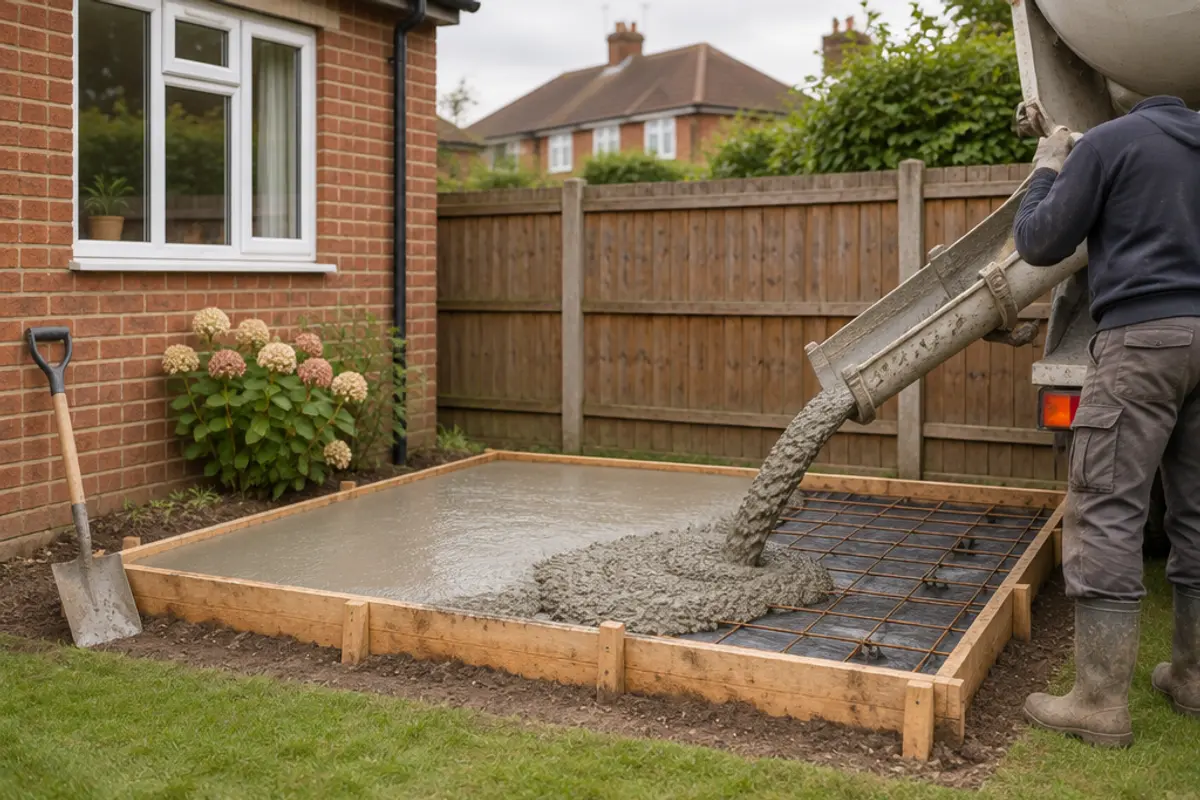
How to use the concrete calculator
- Pick what you're pouring: a slab, a trench footing, post holes, a round pier or steps.
- Measure it and type in the sizes. Each box has its own unit, so you can mix metres and millimetres, or use feet and inches.
- Leave the extra at 10% unless the ground is very flat (5%) or very rough (15%).
- Choose how you'll buy it: bags, mixing your own, or ready-mix by lorry. The result updates as you type.
- Tap Add to shopping list to keep the result, or Share link to send it to your builder.
Why use this calculator
It gives you the answer in the units you actually buy in. Most calculators stop at cubic metres. This one turns that into bags, cement and ballast, or a ready-mix order, using UK bag sizes.
It shows its working. Under How we worked it out you can see every step with your own numbers, so you can check the maths or show it to someone else.
It handles the awkward shapes too. Post holes take the post out of the volume, and steps are counted as a solid block that gets taller with each step.
How we worked it out
Your numbers, step by step. This updates as you change the calculator.
- Volume = length × width × depth = 3 m × 3 m × 0.1 m = 0.9 m³
- Add 10% for waste: 0.9 × 1.1 = 0.99 m³
- Bags: 0.99 m³ ÷ 0.01 m³ per 20 kg bag = 99 bags (or ÷ 0.012 = 83 × 25 kg bags)
The formula
The volume of a rectangle is length × width × depth, all in metres. A slab 3 m by 3 m by 100 mm (0.1 m) is 0.9 m³.
- Post holes: hole volume minus the post, times the number of holes. A round hole uses π × (diameter ÷ 2)² × depth.
- Steps: each step stands on the ones below, so a flight of n steps is width × going × rise × (1 + 2 + … + n).
- Extra: we add your waste percentage on top.
What we assume
- A 20 kg bag of ready-to-use concrete mix makes about 0.01 m³, and a 25 kg bag about 0.012 m³. Brands vary a little, so check the bag.
- A 20 kg bag of Postcrete fills about 0.018 m³.
- Mixing your own uses the BS 8500 standard site mixes: C20 has about 13 bags of 25 kg cement and 1.8 tonnes of all-in ballast per m³. We round cement up to whole bags.
- Mixed concrete weighs about 2,400 kg per m³.
Tips
- Measure the depth in a few places. Ground is rarely flat, and a slab that's 20 mm deeper than planned needs 20% more concrete.
- For about 1 m³ or more, ready-mix is often cheaper and much less work than mixing bags by hand. Get a quote for both.
- Order a little extra. Running short halfway through a pour leaves a weak joint where the old and new concrete meet.
- Put a sub-base of compacted hardcore under slabs and driveways. Use the gravel calculator to work out how much you need.
- For fence posts, Postcrete sets in minutes, so you don't need to brace the post for long.
FAQs
How many bags of concrete do I need for 1 m³?
About 100 bags of 20 kg ready-to-use concrete mix, or about 84 bags of 25 kg. A 20 kg bag makes roughly 0.01 m³ and a 25 kg bag roughly 0.012 m³. For that much, ready-mix is often a better buy.
How much cement and ballast is in 1 m³ of concrete?
For a C20 mix (paths, patios and shed bases), about 13 bags of 25 kg cement (13.2, which the calculator rounds up to 14) and 1.8 tonnes of all-in ballast. For C25 (footings), about 15 bags of cement and 1.8 tonnes of ballast. These figures come from the standard BS 8500 site mixes.
What does a cubic metre of concrete weigh?
About 2,400 kg, or 2.4 tonnes, once mixed. That's worth knowing if you're moving it by wheelbarrow, because it is a lot of barrow loads.
How do I work out concrete for post holes?
Multiply the hole's width by its width again (or use π × radius² for a round hole), then by the depth. Take away the space the post fills, then multiply by the number of holes. Choose Post holes in the calculator and it does this for you.
What's the minimum amount of ready-mix I can order?
Many suppliers deliver from about 1 m³ with a mini-mix lorry, but full-size lorries carry 6 or 8 m³ and part loads can cost extra. Ask your local supplier about mini-mix loads if you only need a few m³.
Should I use C20 or C25 concrete?
C20 is a common choice for paths, patios and shed bases. C25 is stronger and uses more cement, and it is the mix this calculator offers for footings. For anything structural, such as house foundations, building control or your builder decides which mix you need.
 Gravel calculator
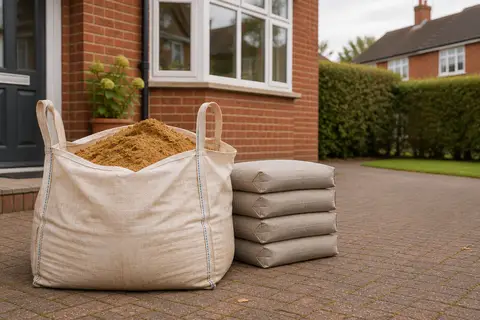 Sand and cement calculator
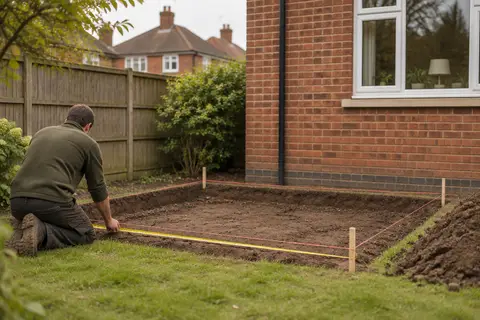 Cubic metre calculator
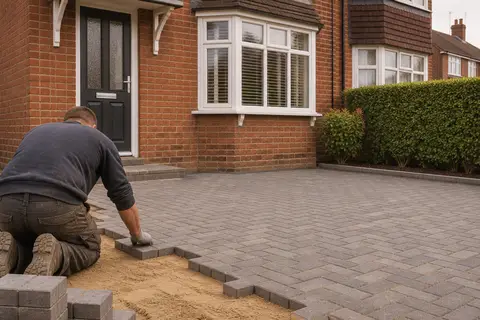 Block paving calculator
 Driveway cost calculator
 Tonnes to m³ converter