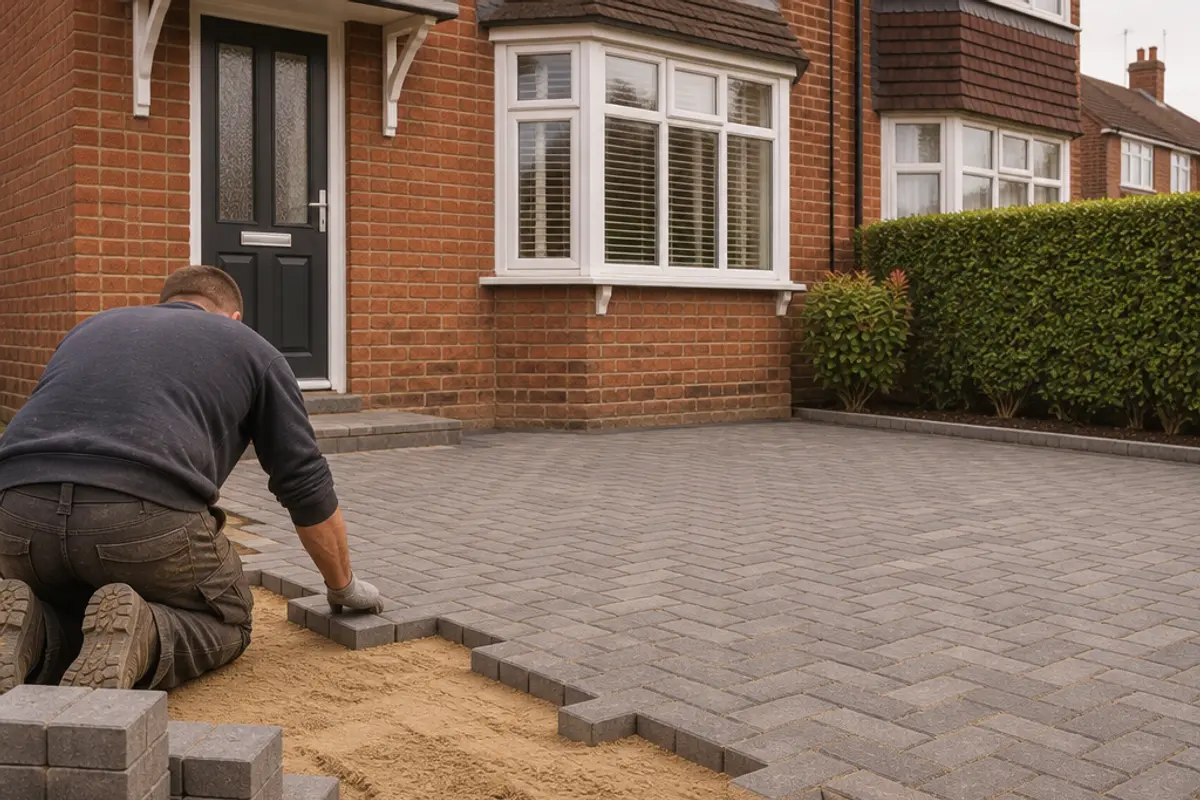
How to use the block paving calculator
- Choose How will you enter the area? Pick length and width, or type in the area if you already know it.
- Enter the sizes. Each box has its own unit, so you can use metres or feet.
- Under What is it for? pick a patio or path (100 mm sub-base) or a driveway (150 mm sub-base).
- Choose the Block size. The standard 200 × 100 mm block is 50 per m². Pick "Another size" and enter the block size including the joint if yours is different.
- Set Extra for cuts. 5 to 10% is usual, and more for herringbone or lots of curves.
- Leave Include edge restraint on if you need edging. Then tap Add to shopping list or Share link.
Why use this calculator
It does the whole build, not just the blocks. You get the blocks, the sand bed, the jointing sand, the sub-base and the edging in one result.
It uses a different sub-base depth for a driveway and a patio. A driveway has to carry a car, so it gets 150 mm. A patio or path gets 100 mm.
It works in the units you buy in. Blocks are counted individually, sand and stone are in tonnes and 850 kg bulk bags, and jointing sand is in 20 kg bags.
It shows its working, so you can check the sums or show them to a landscaper or builder's merchant.
How we worked it out
Your numbers, step by step. This updates as you change the calculator.
- Area = 5 m × 4 m = 20 m²
- Blocks per m² = 50 for 200 × 100 mm blocks
- Blocks = 20 m² × 50 per m² × 1.1 (10% extra) = 1100 blocks
- Sharp sand bed = 20 m² × 50 mm × about 1.7 t/m³ = 1.7 tonnes (it compacts to about 30 mm)
- Jointing sand = 20 m² × 4 kg per m² = 80 kg, or 4 × 20 kg bags
- MOT Type 1 = 20 m² × 100 mm × about 2.1 t/m³ × 1.1 allowance = 4.62 tonnes
- Edge restraint = perimeter 2 × (5 + 4) = 18 m
The formula
Start with the area of the paving in m². Everything else comes from that.
- Blocks = area × blocks per m² × (1 + extra). A 200 × 100 mm block is 1 ÷ (0.2 × 0.1) = 50 per m². For 20 m² with 10% extra: 20 × 50 × 1.1 = 1,100 blocks.
- Sharp sand bed = area × 0.05 m × about 1.7 tonnes per m³. For 20 m²: 20 × 0.05 × 1.7 = 1.7 tonnes.
- Jointing sand = area × 4 kg. For 20 m²: 80 kg, which is 4 bags of 20 kg.
- MOT Type 1 sub-base = area × depth × 2.1 tonnes per m³ × 1.10. For a 20 m² patio at 100 mm: 20 × 0.1 × 2.1 × 1.1 = 4.62 tonnes. For a driveway at 150 mm: 6.93 tonnes.
- Bulk bags = tonnes ÷ 0.85, rounded up.
- Edge restraint = the perimeter of the area. For a rectangle that is 2 × (length + width).
What we assume
- A 200 × 100 mm block gives 50 per m². A few other products come to about 46.5 per m², so use the “Another size” option and enter the block size including the joint if yours is different.
- The sand bed is ordered at 50 mm and compacts to about 30 to 40 mm. Marshalls’ technical sheet says 30 mm compacted, while its blog and some merchants quote 50 mm. We use 50 mm for the order and 30 mm for the dig depth.
- Sharp sand is about 1.7 tonnes per m³ as delivered. Damp sand is heavier.
- Jointing sand is a rule of thumb of 4 kg per m², built from bag coverage claims of about 4 to 5 m² per 20 kg bag. Bags are taken as 20 kg.
- MOT Type 1 is about 2.1 tonnes per m³ once compacted, with 10% added for compaction. Sub-base depths are 100 mm for a patio (Marshalls says 100 mm is enough for most domestic jobs) and 150 mm for a driveway (Marshalls’ minimum).
- If the ground is poor, some guides use 150 mm for a patio. Ask your builder or a landscaper.
Tips
- Dig down far enough. You need the sub-base depth, plus about 30 mm of compacted sand, plus the thickness of your block. The calculator reminds you of this.
- Lay MOT Type 1 in layers no thicker than 75 mm and compact each one. A 150 mm driveway sub-base is two layers.
- Order more blocks for herringbone or curves, because there are more cuts. Keep a few spare for repairs, from the same batch.
- Buy a spare bag of jointing sand. Brush it in, then top up after rain, because the joints settle.
- The price depends on a lot more than materials. For labour and a total cost, see the driveway cost calculator.
- The sub-base and sand bed are also gravel jobs. The gravel calculator has MOT Type 1 if you want to check the sub-base on its own.
FAQs
How many block paving blocks do I need per m²?
50 blocks per m² for standard 200 × 100 mm blocks, plus extra for cuts. With 10% extra that is 55 blocks per m². A 5 m by 4 m patio (20 m²) needs 1,100 blocks.
How much sand do I need for block paving?
About 1.7 tonnes of sharp sand for the bedding layer of a 20 m² patio, laid 50 mm deep, plus 80 kg of jointing sand. The bed compacts to about 30 to 40 mm when it is laid.
How deep should the sub-base be for a block paving driveway?
150 mm of compacted MOT Type 1 for a driveway, and 100 mm for a patio or path. Lay it in layers no thicker than 75 mm and compact each layer.
How much kiln-dried jointing sand do I need per m²?
About 4 kg per m². A 20 kg bag covers around 5 m². That is a rule of thumb that covers the first fill and one top-up, so buy a spare bag.
How many extra blocks should I order for cutting and herringbone?
5 to 10% for a plain pattern. Herringbone and curves need more cuts, so go towards or beyond the top of that range.
How many bags of bedding sand and tonnes of MOT Type 1 do I need?
For a 20 m² patio, 1.7 tonnes of sharp sand, which is 2 bulk bags, and 4.6 tonnes of MOT Type 1, which is 6 bulk bags of 850 kg. A driveway of the same size needs about 6.9 tonnes of MOT Type 1 because the sub-base is 150 mm.
 Gravel calculator
 Driveway cost calculator
 Concrete calculator
 Square metre calculator
 Sand and cement calculator
 Project shopping list