How to use the sand and cement calculator
- Under What is the job? pick floor screed, a mortar bed under paving, bricklaying or blockwork mortar, wall render, or concrete.
- Choose How will you give the size? Either an area and thickness, or a volume if you already know it.
- Type in the Area and Thickness, or the Volume. Typical thicknesses are 50–75 mm for screed, 30–40 mm for a paving bed, 15–20 mm for render and 100 mm for a concrete slab.
- Pick your mix. Mortar, beds and render use cement to sand from 1:3 to 1:6. Screed uses cement to sharp sand from 1:3 to 1:4.5. Concrete uses cement, sand and aggregate.
- Leave Extra for waste at 10%, or change it.
- Read the cement and sand, then tap Add to shopping list to keep them or Share link to send them to your builder.
Why use this calculator
One tool for every mix. Instead of five calculators with five sets of numbers, you pick the job and it uses the right mix table and the right sand.
It picks the right sand. Screed, paving beds and concrete use sharp sand, and bricklaying and render use building sand. The tonnes and the bulk bags reflect that.
It shows bags of cement per tonne of sand. That is handy if your merchant sells sand by the tonne and you mix by the bag.
It shows its working. Under How we worked it out you can see every step with your own numbers.
How we worked it out
Your numbers, step by step. This updates as you change the calculator.
- Volume = area × thickness = 10 m² × 0.05 m = 0.5 m³
- Add 10% for waste: 0.5 × 1.1 = 0.55 m³
- At 1:4, 1 m³ of floor screed needs about 13.8 bags of cement, so 0.55 m³ needs about 7.59, round up to 8 × 25 kg bags
- Sharp sand = 0.55 m³ × 0.96 m³ of sand per m³ = 0.528 m³, × 1.7 t/m³ = about 0.9 tonnes (2 bulk bags of 850 kg)
The formula
The volume is area × thickness, in metres, or the volume you type in. We add your waste percentage, then multiply by the figures for your mix. A 10 m² paving bed at 40 mm is 10 × 0.04 = 0.4 m³.
- Cement: volume × bags of 25 kg per m³ for the mix, rounded up.
- Sand: volume × m³ of sand per m³, then × the sand’s weight a m³ (1.6 tonnes for building sand, 1.7 for sharp sand).
- Mortar, beds and render: 1:3 takes 18 bags of cement and 0.94 m³ of sand per m³. 1:4 takes 14.4 and 1.0. 1:5 takes 12 and 1.04. 1:6 takes 10.3 and 1.07.
- Screed: 1:3 takes 17.3 bags and 0.9 m³ of sharp sand per m³. 1:4 takes 13.8 and 0.96. 1:4.5 takes 12.6 and 0.98.
- Concrete: 1:1.5:3 takes 16 bags and 1.8 tonnes of all-in ballast per m³. 1:2:4 takes 13 bags and 1.85 tonnes. 1:3:6 takes 9 bags and 1.9 tonnes. You can also batch by volume with sand and 20 mm aggregate.
What we assume
- Mixes are by volume. Wall render uses the same cement and building sand figures as mortar, and a paving bed uses the mortar figures with sharp sand.
- Mortar and screed quantities are worked out from standard volumes, not from a maker’s table. Treat them as good to about 8% either way. Concrete is worked out for mixes batched by volume, and cross-checked against the BS 8500 standard site mixes.
- Building sand weighs about 1.6 tonnes a m³ and sharp sand about 1.7. A bulk bag holds 850 kg.
- Damp sand bulks up, so merchants’ tonnes can differ from ours.
- Screed below 25 mm gets a warning, because that is the minimum for any sand and cement screed.
Tips
- Cement bags are rounded up and sand is in tonnes. Merchants sell sand by weight, and damp sand weighs more, so ask your merchant for their own figure.
- 1:6 is a weak mix. Use it only for sheltered, low-load work. For outdoor walls, paving beds and floors, use 1:4 or stronger.
- Over about 1 m³ of concrete, ready-mix delivered by lorry is often cheaper and quicker than mixing by hand. Use the concrete calculator to compare.
- Doing a particular job? The screed calculator, mortar calculator and brick calculator work out the volume for you.
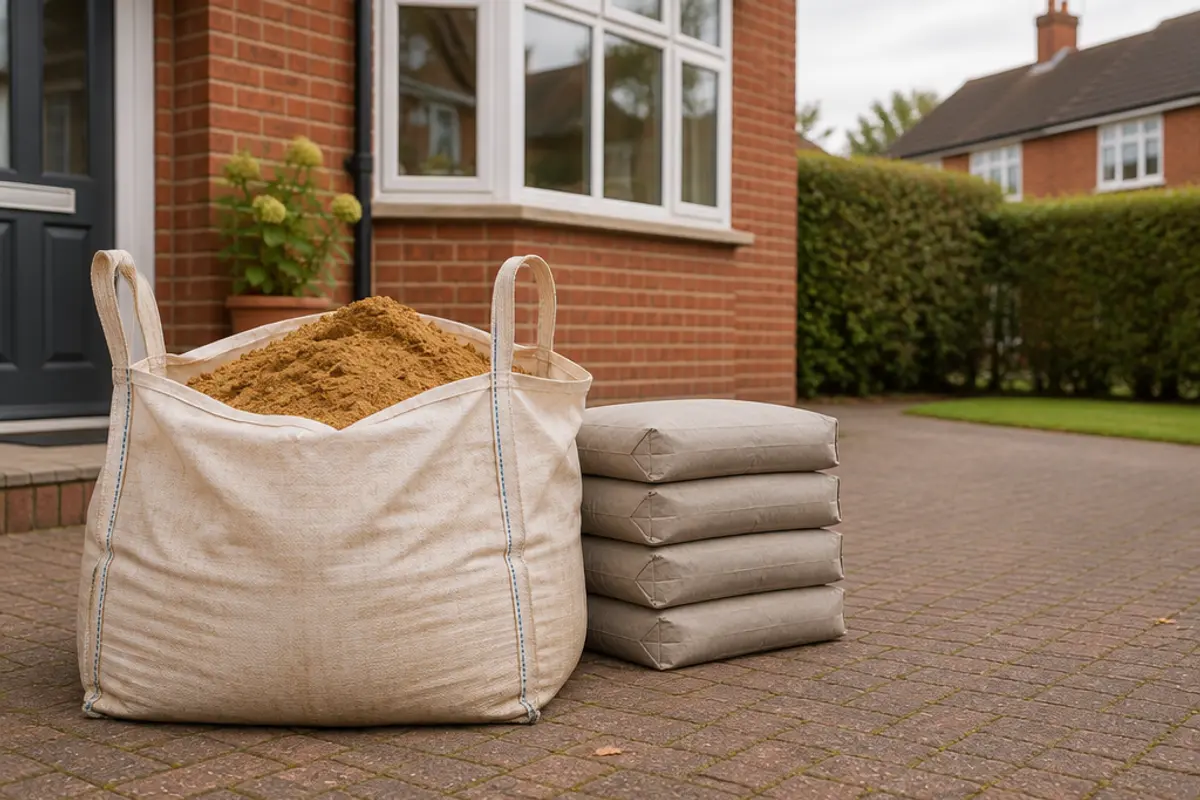
- Buying a bulk bag? It holds about 850 kg, which is roughly 0.5 m³ of sand.
 Screed calculator
 Mortar calculator
 Brick calculator
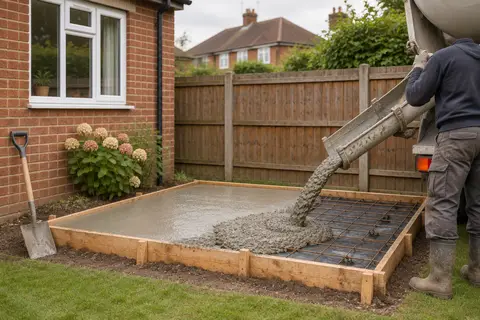 Concrete calculator
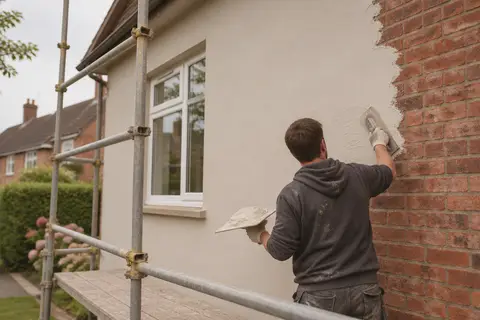 Rendering cost calculator
 Project shopping list