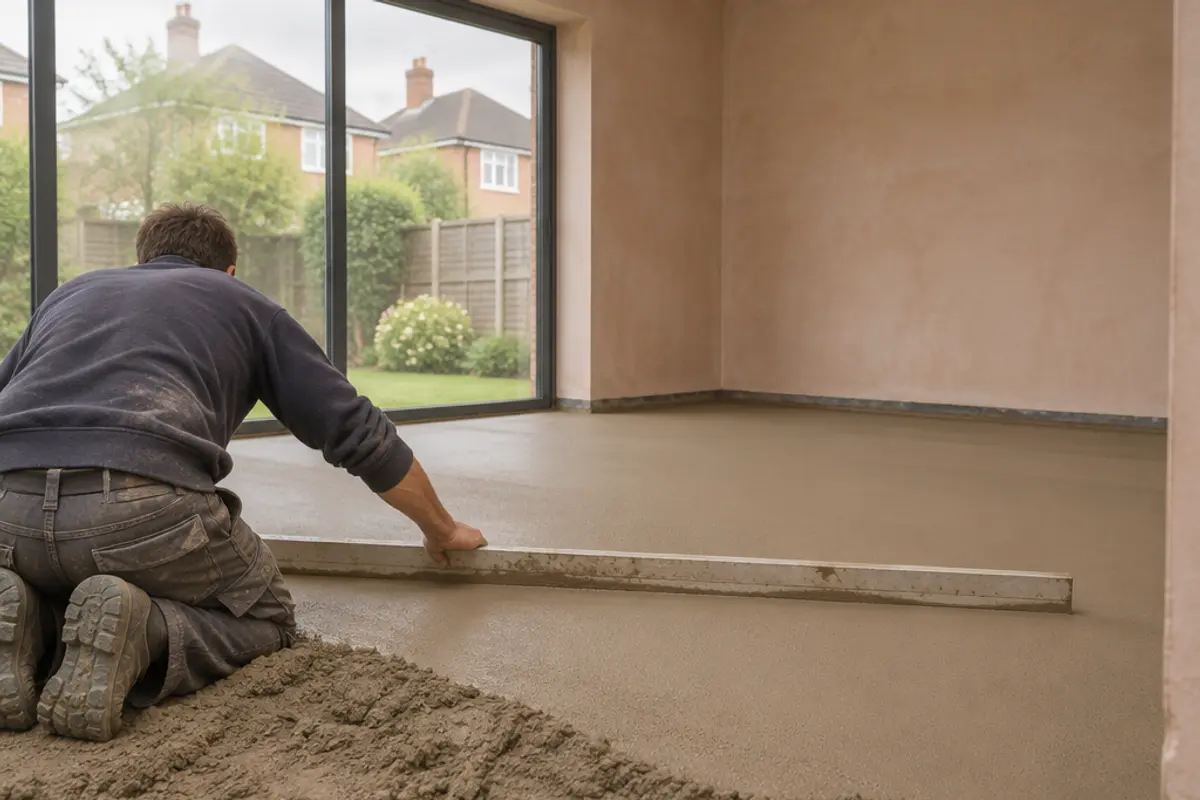
How to use the screed calculator
- Choose how to give the floor size: Length and width of the room, or I already know the area.
- Pick the Type of screed: bonded, unbonded, floating (normal or heavy loads) or over underfloor heating. This sets the minimum thickness we check.
- Type in the Screed thickness. Count the screed only, not the insulation under it.
- Under What will you use? pick a 1:3, 1:4 or 1:4.5 mix to make yourself, or bagged ready-mixed dry screed.
- Leave Extra for waste and uneven slab at 10%, or raise it if the slab underneath is rough or out of level.
- Read the cement, sand and weight, then tap Add to shopping list to keep them or Share link to send them to your builder.
Why use this calculator
It checks your thickness. Each type of screed has a minimum, and you get a warning if yours is too thin. Thin sand and cement screed cracks and can come loose.
It gives you both ways to buy. Mix it yourself and you get bags of cement and tonnes of sharp sand with bulk bag counts. Buy it bagged and you get the number of 25 kg bags.
It tells you the weight. Screed is heavy, which matters on upper floors, so you get the total tonnes and the kg a m².
It shows its working. Under How we worked it out you can see every step with your own numbers.
How we worked it out
Your numbers, step by step. This updates as you change the calculator.
- Floor area = length × width = 5 m × 4 m = 20 m²
- Volume = area × thickness = 20 m² × 0.065 m = 1.3 m³
- Add 10% for waste: 1.3 × 1.1 = 1.43 m³
- At 1:4, 1 m³ of screed needs about 13.8 bags of cement, so 1.43 m³ needs about 19.73, round up to 20 × 25 kg bags
- Sharp sand = 1.43 m³ × 0.96 m³ per m³ of screed = 1.373 m³, × 1.7 t/m³ = about 2.33 tonnes (3 bulk bags of 850 kg)
- Weight on the floor = 1.3 m³ × 2000 kg/m³ = about 2.6 tonnes (130 kg per m²)
The formula
The volume of screed is floor area × thickness, in metres. A 5 m by 4 m floor is 20 m², and at 65 mm (0.065 m) that is 1.3 m³. With 10% waste it is 1.43 m³.
- Cement: volume × bags of cement per m³ for your mix, rounded up. 1:3 takes 17.3 bags, 1:4 takes 13.8 and 1:4.5 takes 12.6. For 1.43 m³ at 1:4 that is 19.7, so 20 bags.
- Sharp sand: volume × m³ of sand per m³ of screed (0.9 for 1:3, 0.96 for 1:4, 0.98 for 1:4.5) × 1.7 tonnes a m³. For 1.43 m³ at 1:4 that is about 2.3 tonnes, or 3 bulk bags.
- Bagged screed: volume × 2,000 kg a m³ ÷ 25 kg a bag, rounded up. For 1.43 m³ that is 115 bags.
- Weight: volume before waste × 2,000 kg a m³. For 1.3 m³ that is 2.6 tonnes, or about 130 kg a m².
What we assume
- The mixes are cement to sharp sand by volume. The range of 1:3 to 1:4.5 comes from the Concrete Centre.
- The cement and sand quantities are worked out from standard densities, not from a maker’s table. Treat them as good to about 8% either way. Water adds no volume.
- Laid screed weighs about 2,000 kg a m³ (the range is 1,800 to 2,200). We use the same figure for bagged screed.
- A bag of ready-mixed screed is taken as 25 kg, a common retail size. Check the bag you buy.
- Minimum thicknesses are 25 mm bonded, 50 mm unbonded, 65 mm floating, 75 mm floating for heavy loads and 65 mm over underfloor heating. For unbonded screed we also say when you are under the recommended 70 mm.
- Liquid screed, calcium-sulphate screed and self-levelling compounds are different products and are not covered.
Tips
- Don't skimp on thickness. The minimum depends on the type: a floating screed on insulation needs 65 mm, much more than a bonded screed on a slab.
- If the slab underneath is uneven, measure the depth in several places and raise the waste to 15% or more. Low spots swallow a lot of screed.
- Over underfloor heating, check the heating maker's manual for how deep they want the screed over the pipes. Liquid and calcium-sulphate screeds can be thinner, but they are different products and are not worked out here.
- For a floor of about 1 m³ or more, get a quote for delivered screed as well as pricing the bags. Mixing a big floor by hand is hard work.
- Ask your supplier how long the screed needs to dry before you lay flooring. It depends on the thickness and the type of screed.
- Laying tiles on top? Work out the tiles, adhesive and grout with the tile calculator. Need the same mix for another job? Use the sand and cement calculator.
 Sand and cement calculator
 Concrete calculator
 Tile calculator
 Cubic metre calculator
 Tonnes to m³ converter
 Project shopping list