How to use the tile calculator
- Choose Floor or Wall, then give the area as length × width, or type in the m² if you already know it.
- Take off any area you will not tile, such as a window, a bath panel or a shower tray.
- Pick your tile size from the list, or choose Another size and type in the length and width.
- Choose your layout: straight, diagonal or herringbone. This sets the extra for cuts.
- Tell us what the box says, either tiles per box or m² per box.
- Leave Also work out adhesive and grout on, then pick the trowel notch, tile thickness and joint width. Tap Add to shopping list or Share link to keep the result.
Why use this calculator
It does the whole job in one go. Many tile tools stop at the number of tiles. This one gives you tiles, boxes, bags of adhesive and bags of grout, so you can buy everything for the job in one trip.
It uses practical adhesive figures, not best-case ones. The maths is explained under How we worked it out and in the notes below, so you can see where the numbers come from.
It allows for how you lay the tiles. Straight lay needs fewer spare tiles than a diagonal or herringbone layout, and the extra is shown in the working.
How we worked it out
Your numbers, step by step. This updates as you change the calculator.
- Area = 4 m × 3 m = 12 m²
- One tile = 600 mm × 600 mm = 0.36 m², so about 2.8 tiles per m²
- Add 10% for cuts and breakages (straight layout): 12 m² × 1.1 = 13.2 m²
- Tiles = 13.2 m² ÷ 0.36 m² per tile = 37 tiles (34 to cover the area itself)
- Boxes = 37 tiles ÷ 4 per box = 10 boxes
- Adhesive: 12 m² × 6.5 kg per m² (10 mm notch, a practical rate) × 1.1 for waste = 85.8 kg
- Adhesive bags = 85.8 kg ÷ 20 kg bags, rounded up = 5
- Grout per m² = ((600 + 600) ÷ (600 × 600)) × 9 mm thick × 3 mm joint × 1.6 = 0.144 kg
- Grout = 12 m² × 0.144 kg × 1.1 for waste = 1.9 kg
- Grout bags: 1.9 kg needs 1 × 2.5 kg (2.5 kg)
The formula
- Area to tile: length × width, minus any area you will not tile.
- Tiles: area × (1 + wastage) ÷ area of one tile, rounded up. A 600 × 600 mm tile is 0.36 m².
- Boxes: tiles ÷ tiles per box, rounded up. If your box gives m², it is area with wastage ÷ m² per box.
- Adhesive: area × kg per m² for your trowel notch × 1.1, then ÷ the bag size, rounded up.
- Grout: ((tile length + tile width) ÷ (tile length × tile width)) × tile thickness × joint width × 1.6, all in millimetres, gives kg per m². We then multiply by the area and add 10%.
For a 4 m by 3 m floor in 600 × 600 mm tiles: 12 m² × 1.10 = 13.2 m², ÷ 0.36 = 36.7, so 37 tiles. Adhesive at a 10 mm notch: 12 × 6.5 × 1.1 = 85.8 kg, which is 5 bags of 20 kg. Grout at 9 mm thick with 3 mm joints: 0.144 kg per m², so 1.9 kg for the floor with 10% extra.
What we assume
- Wastage: 10% for straight lay, 15% for diagonal or herringbone. Brick bond is usually 10 to 15%. Some shops quote more for herringbone and mosaics.
- Adhesive, practical and datasheet rates: the datasheet figure for a notch is the best case, on a flat surface. For a 6 mm notch it is about 2 kg per m². In real jobs the bed is thicker, and one UK tile retailer says a 20 kg bag covers only 4 to 5 m² at 6 mm. We use the practical rate: 4.5 kg per m² at 6 mm, 6.5 kg at 10 mm, 8 kg at 12 mm. The 12 mm figure is our estimate, built from the 10 mm range. Always check the bag.
- Adhesive bag size: 20 kg is the UK norm. You can change it.
- Grout joints: 2 mm for walls and 3 mm for floors by default. The usual ranges are 2 to 3 mm on walls and 3 to 5 mm on floors, and natural stone or uneven tiles need more.
- Grout formula: the one in Mapei’s technical data sheet, with a density factor of 1.6. Other grouts differ a little.
- Grout bags: 2.5, 5 and 10 kg, picked so you buy the least extra.
- Tile thickness: the calculator starts at 9 mm. Wall tiles are usually 6 to 9 mm and porcelain floor tiles 9 to 10 mm, so change it to match your box.
Tips
- Buy all your tiles at once, from the same batch. Shade and size can vary between batches, and a tile you buy later may not match.
- Keep a few spare tiles in the loft. If one cracks in five years, you can still replace it.
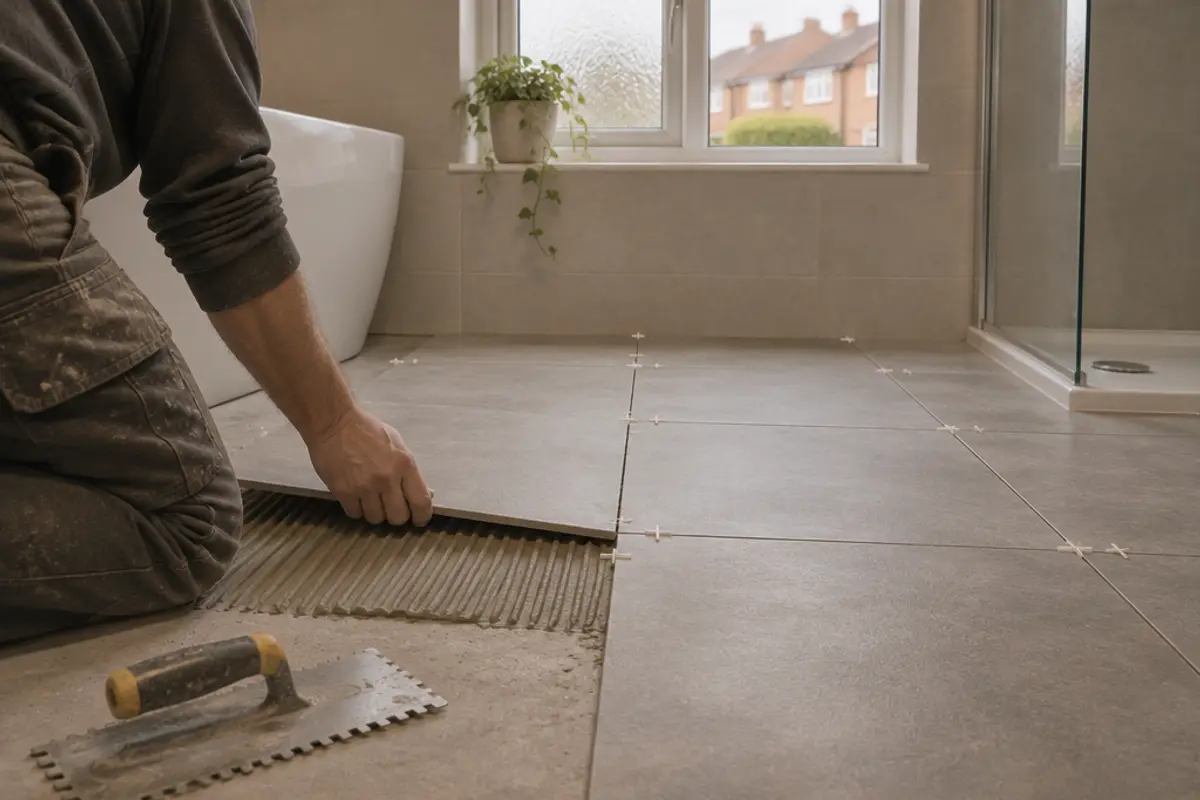
- Lay a row out dry before you fix anything. It shows you where the cuts fall, and you can move the start line so you do not end up with thin slivers at the walls.
- Large tiles, 600 mm and over, need adhesive on the back of the tile as well as the floor or wall. This can roughly double the adhesive you use.
- Need the m² of an awkward room first? Use the square metre calculator, and for a screed or levelling layer under the tiles try the screed calculator.
 Square metre calculator
 Screed calculator
 Paint calculator
 Wallpaper calculator
 Project shopping list