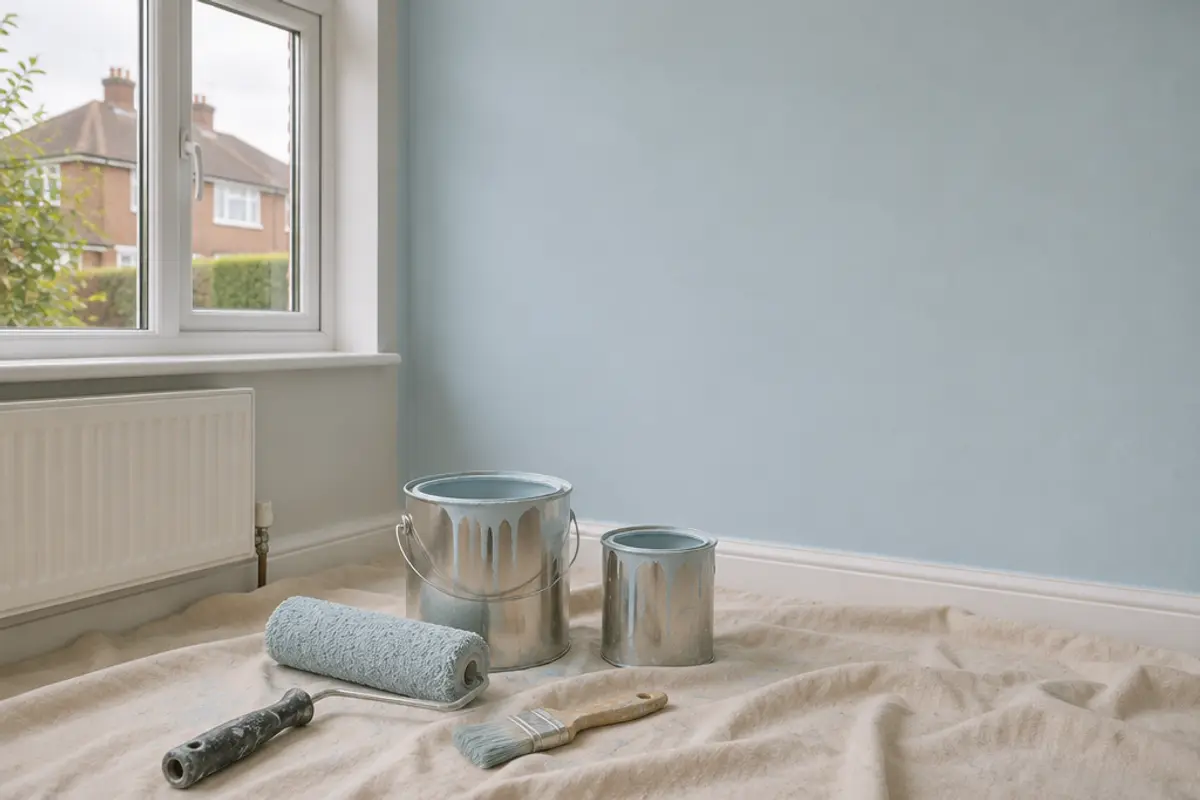
How to use the paint calculator
- Choose what you are painting: the walls of a room, the ceiling, both, or one area where you know the m².
- Type in the room length and width. For walls, add the wall height and the number of doors and windows.
- Pick the type of paint: emulsion for walls, ceiling paint, satinwood or gloss for woodwork, masonry paint, or woodstain.
- Set the number of coats. Two is standard.
- Fresh, bare plaster? Turn on New bare plaster? Add a mist coat. The mist coat is added to the total.
- Check the tins in the result, then tap Add to shopping list or Share link to keep it.
Why use this calculator
It takes off doors and windows for you. Each door is 1.5 m² and each window 1.2 m². You only need to count them, not measure them.
It copes with new plaster. Bare plaster soaks up paint, so the first coat is a thinned-down mist coat. We work out how much paint and how much water that takes, and add the paint to your total.
It rounds to real tin sizes. Wall and ceiling paint is worked out in 2.5 litre and 5 litre tins, and woodwork paint in 750 ml and 2.5 litre tins. We pick the mix with the least paint left over. The working shows every step, so you can check it.
How we worked it out
Your numbers, step by step. This updates as you change the calculator.
- Walls: distance round the room = 2 × (4 m + 4 m) = 16 m; × 2.4 m high = 38.4 m²
- Take off 1 door (1.5 m² each) and 1 window (1.2 m² each) = 2.7 m², leaving 35.7 m² of wall
- Walls (emulsion): 35.7 m² × 2 coats ÷ 12 m² per litre = 5.95 litres
- Walls tins: 5.95 litres needs 1 × 5 L + 1 × 2.5 L = 7.5 L
- Total paint = 5.95 litres over 35.7 m²
The formula
- Walls: the distance round the room, 2 × (length + width), × the wall height, minus the doors and windows.
- Ceiling: length × width.
- Litres: area × number of coats ÷ coverage in m² per litre.
- Mist coat (new plaster): area ÷ 12 gives the litres of mix. 70% of that is paint and 30% is water. The paint is added to your total.
- Tins: we choose the mix of tin sizes that covers the litres with the least paint left over, then the fewest tins.
For a 4 m by 4 m room, 2.4 m high, with one door and one window, the walls are 16 m round. 16 × 2.4 = 38.4 m², minus 1.5 m² for the door and 1.2 m² for the window leaves 35.7 m². Two coats at 12 m² per litre is 35.7 × 2 ÷ 12 = 5.95 litres. Two 2.5 litre tins is only 5 litres, so the best buy is one 5 litre and one 2.5 litre tin, 7.5 litres in total.
What we assume
- Coverage per coat: 12 m² per litre for emulsion, ceiling paint, satinwood and gloss. Manufacturers quote up to 13 to 17 m² per litre on smooth, sealed surfaces, so 12 is a cautious planning figure.
- Masonry paint: 12 m² per litre on smooth render and 5 m² per litre on textured render or pebbledash. Textured surfaces vary a lot, so treat it as a minimum.
- Woodstain: 6.4 m² per litre. This comes from decking stain only. Rough or sawn timber can take far more.
- Doors and windows: a door is 1.5 m² (a standard 1981 × 762 mm door). A window is 1.2 m², a typical double casement. There is no standard window size, so this is a guess.
- Mist coat: 12 m² per litre of mixed paint, one mist coat and then your normal coats. No UK manufacturer publishes a mist coat figure, so this is a rule of thumb.
- Tin sizes: 2.5 and 5 litres for wall, ceiling and masonry paint. 750 ml and 2.5 litres for satinwood, gloss and woodstain. Other sizes exist, such as 1 litre and 10 litres, but we leave them out. Check what your shop sells.
- Ceiling height: 2.4 m unless you change it.
Tips
- Mix all the tins for one wall in a bigger container before you start. Colour can vary a little between tins, and mixing them evens it out.
- Keep what is left over for touch-ups. Write the colour name and the date on the lid.
- For skirting boards and doors, choose One wall or area and Satinwood or Gloss, then type in the area. Woodwork paint is bought in smaller tins.
- Coverage drops on rough, dark or porous surfaces, and a big colour change may need a third coat. If you are changing a dark wall to white, check what the tin says.
- Doing the whole room? Use the square metre calculator to measure odd shapes, and the wallpaper calculator if one wall will be papered instead.
 Wallpaper calculator
 Square metre calculator
 Plaster calculator
 Tile calculator
 Project shopping list