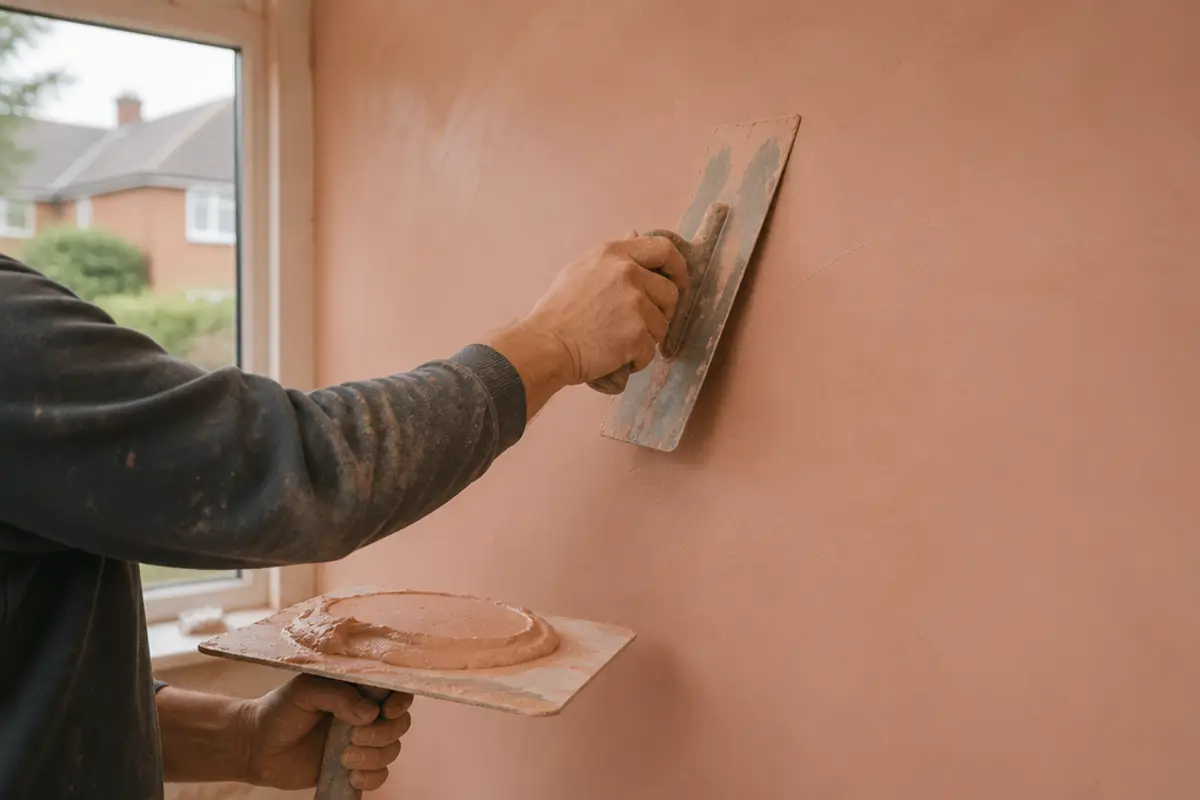
How to use the plaster calculator
- Under What are you plastering? pick the walls and ceiling of a room, the walls, the ceiling, or I know the area.
- Type in the room sizes, or the area. For walls, add the area of doors and windows if you want it taken off. Some plasterers only take off big openings.
- Pick the Type of plaster: multi-finish skim (2 mm), bonding coat (11 mm on smooth, dense walls, 8 mm on plasterboard and ceilings), hardwall, Dri-coat or one-coat plaster.
- If you picked an undercoat, leave Also skim over it with multi-finish switched on. Undercoats are normally finished with a 2 mm skim.
- Leave Extra for waste at 15%. 10–20% is usual.
- Read the bags for each coat, then tap Add to shopping list to keep them or Share link to send them to your plasterer.
Why use this calculator
It works out each coat separately. An undercoat and the skim over it are different products with different coverage, so you see a bag count for each, and a total.
It uses published coverage for each coat and thickness. The figures come from British Gypsum's Thistle range, with the source listed on the page. Other brands can differ, so always check the figure on your bag.
It warns you about common mistakes, such as putting multi-finish straight onto bare brick, or using an 11 mm coat on a ceiling.
It shows its working. Under How we worked it out you can see every step with your own numbers.
How we worked it out
Your numbers, step by step. This updates as you change the calculator.
- Walls = 2 × (4 m + 3.5 m) × 2.4 m = 36 m², less 3 m² of openings = 33 m²
- Ceiling = 4 m × 3.5 m = 14 m²
- Total area = 33 + 14 = 47 m²
- Multi-finish skim: one 25 kg bag covers about 10 m² at 2 mm. 47 m² × 1.15 (15% waste) ÷ 10 = 5.4, round up to 6 bags
The formula
First the area. Walls are 2 × (length + width) × height, less any openings. The ceiling is length × width. For a 4 m by 3.5 m room, 2.4 m high, with 3 m² of openings, the walls are 33 m² and the ceiling 14 m², a total of 47 m².
- Bags of a coat: area × (1 + waste) ÷ coverage of one 25 kg bag, rounded up. Multi-finish on 47 m² with 15% waste is 47 × 1.15 ÷ 10 = 5.4, so 6 bags.
- Undercoat plus skim: each coat is worked out separately. 33 m² of 11 mm bonding coat is 33 × 1.15 ÷ 2.75 = 13.8, so 14 bags, and the skim is 33 × 1.15 ÷ 10 = 3.8, so 4 bags. That is 18 bags in all, or 450 kg of powder.
- Coverage a 25 kg bag: multi-finish 10 m² at 2 mm. Bonding coat 2.75 m² at 11 mm or 3.5 m² at 8 mm. Hardwall 3.0 m² at 11 mm. Dri-coat 3.25 m² at 11 mm. One-coat plaster 2.25 m² at 13 mm.
What we assume
- Coverage figures are for British Gypsum Thistle products. The 8 mm bonding coat figure is a merchant’s figure, not the maker’s.
- Every bag is 25 kg.
- Coverage is quoted at the stated thickness. Rough, thirsty or uneven backgrounds use more.
- A skim is normally put over an undercoat. Beading, PVA and other extras are not included.
Tips
- Multi-finish is a thin finishing coat. Put it on plasterboard or over an undercoat, never straight onto bare brick.
- Use the 11 mm coats on walls. Use the 8 mm bonding coat on plasterboard and ceilings.
- Coverage depends on the wall. Rough, thirsty or uneven backgrounds use more plaster. A real skim can run thicker than 2 mm, so cover goes down.
- Each bag is 25 kg, and a whole room can be 150 kg or more. Plan how you will carry it in.
- Boarding the room first? Work out the sheets with the plasterboard calculator. Painting afterwards? Use the paint calculator.
 Plasterboard calculator
 Paint calculator
 Brick calculator
 Wallpaper calculator
 Square metre calculator
 Project shopping list