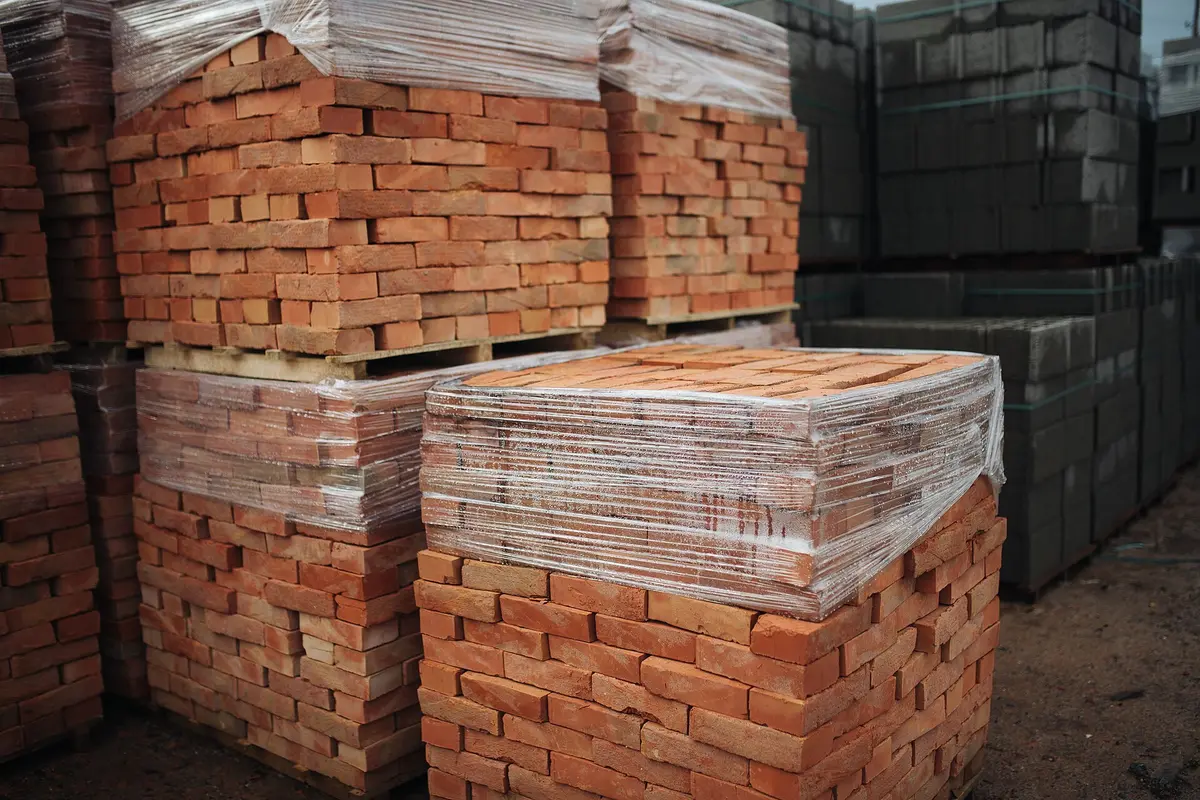
How to use the brick calculator
- Under What are you building with? choose bricks (215 × 102.5 × 65 mm) or concrete blocks (440 × 215 mm face).
- Type in the Wall length and Wall height. Each box has its own unit, so you can use metres, feet or millimetres.
- Add up every door and window and put the total in Doors and windows (total area). We take it off the wall.
- For bricks, pick the Wall thickness: single skin, double skin (solid) or cavity wall. For blocks, pick the Block thickness.
- Leave Extra for cuts and breakages at 5% and pick your Mortar mix. 1:4 is a good general choice.
- Read the numbers, then tap Add to shopping list to keep them or Share link to send them to your builder.
Why use this calculator
It counts the whole job, not just the bricks. After the number to order you get the mortar in m³, the 25 kg bags of cement and the tonnes of building sand, so one tool covers the shopping list.
It handles the walls people actually build. Single skin, solid one-brick walls and cavity walls with brick on both sides all have their own numbers. Blockwork has its own setting, where the block thickness changes the mortar.
It shows its working. Under How we worked it out you can see every step with your own numbers, so you can check the maths or show it to your supplier.
How we worked it out
Your numbers, step by step. This updates as you change the calculator.
- Wall area = length × height = 6 m × 2 m = 12 m²
- Bricks = area × 60 bricks (single skin) per m² = 12 × 60 = 720
- Add 5% for waste: 720 × 1.05 = 756, round up to 756 bricks
- A single-skin brick wall takes about 0.032 m³ of mortar per m² (this includes filling the frogs and the bedding).
- Mortar = 12 m² × 0.032 m³/m² × 1.05 = about 0.403 m³
- At 1:4, 1 m³ of mortar needs about 14.4 bags of cement, so 0.403 m³ needs about 5.81, round up to 6 bags (25 kg)
- Building sand = 0.403 m³ × 1 m³ of sand per m³ of mortar × 1.6 t/m³ = about 0.65 tonnes (1 bulk bag of 850 kg)
The formula
The wall area is length × height, less any doors and windows. A wall 6 m long and 2 m high is 12 m².
- Bricks: area × 60 for a single skin wall, or area × 120 for a one-brick-thick wall. A cavity wall with brick on both sides is two single skins, so it is also 120 a m². Then we add your waste percentage. For 12 m² that is 720, or 756 with 5% extra.
- Blocks: area × 10, plus your waste percentage.
- Mortar: area × the mortar a m² needs, plus waste. A single skin wall takes about 0.032 m³ a m², a one-brick wall about 0.08 m³ and a cavity wall about 0.064 m³ (two single skins). Blockwork takes 0.0049 m³ a m² for 75 mm blocks, 0.0066 for 100 mm, 0.0092 for 140 mm and 0.0141 for 215 mm, and we add at least 20% extra.
- Cement and sand: mortar volume × the figures for your mix. At 1:4, 1 m³ of mortar needs 14.4 bags of cement and 1.0 m³ of building sand (about 1.6 tonnes). We round the bags up.
What we assume
- Bricks are 215 × 102.5 × 65 mm, laid in stretcher bond with 10 mm joints. Other bonds, such as Flemish, can use different numbers.
- Blocks are 440 × 215 mm on the face with 10 mm joints.
- The mortar figures for bricks include filling the frogs and the bedding. They come from a mortar maker’s data sheet.
- Cement and sand quantities are worked out from standard volumes, not from a maker’s table. Treat them as good to about 8% either way.
- Building sand weighs about 1.6 tonnes a m³ and a bulk bag holds 850 kg. Damp sand bulks up, so merchants’ figures can differ.
- Lime mortars, plasticisers and the cavity extras (ties, insulation, trays) are not included.
Tips
- Order all your bricks in one go. Different batches can vary a little in colour and size.
- Brick courses rise 75 mm each (a 65 mm brick plus a 10 mm joint). A wall height that is a multiple of 75 mm needs fewer cut bricks.
- A cavity wall also needs wall ties, insulation and cavity trays. They are not counted here. If the inner leaf is blockwork, work out the brick leaf as single skin and the inner leaf with the block option.
- This calculator assumes standard metric bricks. If yours are reclaimed, imperial or another size, check the number per m² with your supplier.
- A new wall needs a proper foundation. Work out the concrete with the concrete calculator, and ask your builder or building control how deep and wide the footing should be.
- Want the mortar worked out on its own, or in a different mix? Try the mortar calculator.
FAQs
How many bricks do I need per m² for a single skin wall?
60 bricks per m² for a half-brick (single skin) wall of standard 215 × 102.5 × 65 mm bricks with 10 mm joints. The exact sum is 59.3, and UK suppliers round it up to 60.
How many bricks are in a double skin or cavity wall?
About 120 per m² for a solid one-brick-thick (215 mm) wall. A cavity wall with brick on both sides also takes 120 per m², because each leaf is 60. If the inner leaf is block, you need 60 bricks and 10 blocks per m².
How many blocks do I need per m²?
10 blocks per m² for 440 × 215 mm blocks with 10 mm joints. It is the same for 75, 100, 140 and 215 mm thick blocks, because the face is the same size.
How much extra should I allow when ordering bricks?
5% is usual for a plain wall. Use 10% if the wall has lots of corners or curves, or if the bricks are old.
How much sand and cement do I need for 1,000 bricks?
About 8 bags of 25 kg cement and 0.85 tonnes of building sand at a 1:4 mix for a single skin wall, before waste. With 10% waste, plan for 9 bags and about 0.94 tonnes of sand.
How do I work out bricks for a wall with a door or window?
Work out the area of each opening, add them up and take the total off the wall area. A standard door is about 1.6 m², but windows vary, so measure yours. Type the total into Doors and windows and the calculator does the rest.
What size is a standard UK brick?
215 × 102.5 × 65 mm. With a 10 mm mortar joint it takes up a 225 × 75 mm space on the face of the wall, which is why about 60 fit in a m².
 Mortar calculator
 Sand and cement calculator
 Concrete calculator
 Plaster calculator
 Rendering cost calculator
 Project shopping list
