How to use the gravel calculator
- Choose the Shape of the area: a rectangle, circle, triangle, or type in the area if you already know it.
- Measure it and enter the sizes. Each box has its own unit, so you can use metres, feet or millimetres.
- Under What are you laying? pick gravel, pea shingle, slate chippings, MOT Type 1 or crushed concrete.
- Under What is it for? pick decorative area (40 mm), path (40 mm) or driveway (50 mm) for the top layer. For the stone underneath, pick a sub-base: patio or path (100 mm) or driveway (150 mm), and set What are you laying? to MOT Type 1. Choose "I will enter my own depth" if you want something different.
- Leave Extra for settling and waste at 5% unless you have a reason to change it. MOT Type 1 uses a fixed 10% for compaction instead.
- Read the tonnes and the bag counts, then tap Add to shopping list to keep them or Share link to send them to your supplier.
Why use this calculator
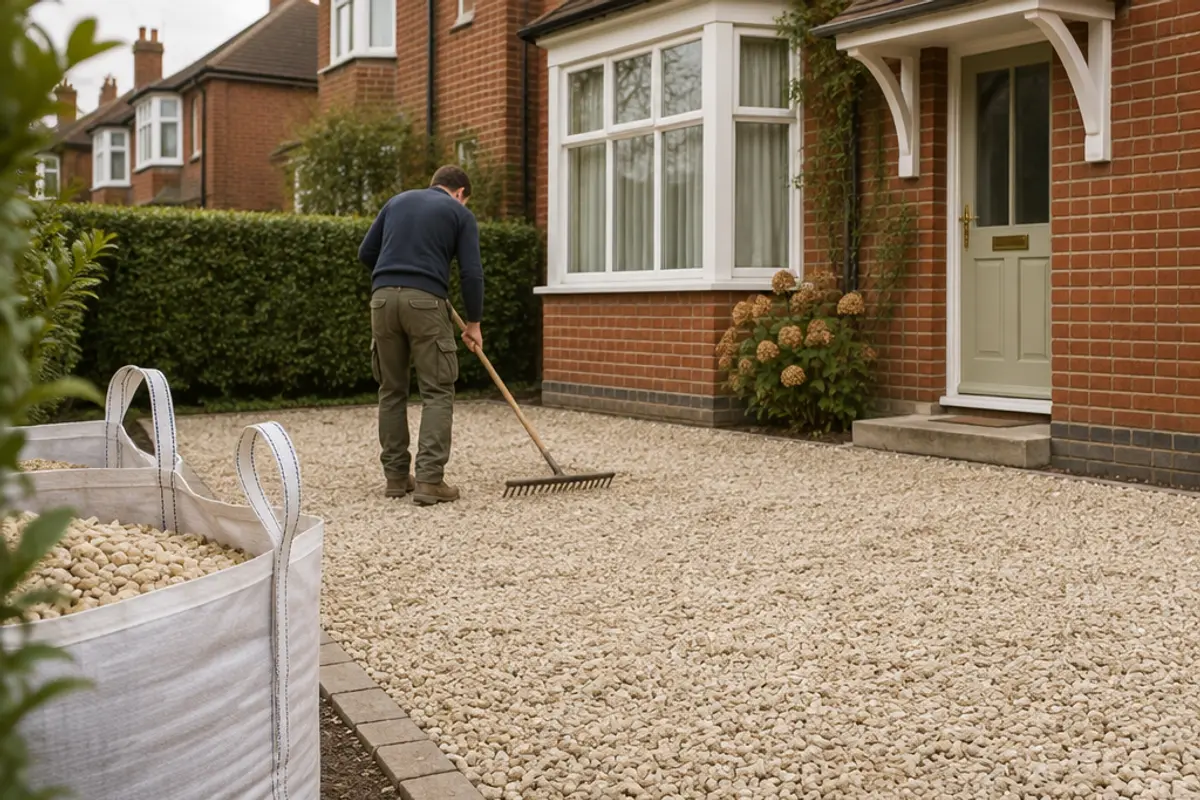
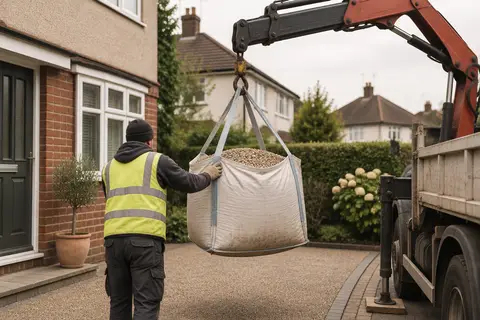
It gives you the answer in the units gravel is sold in. Most gravel calculators stop at a tonnage. This one also gives bulk bags (850 kg) and 25 kg bags, and tells you how many square metres a tonne covers at your depth.
It sets a sensible depth for the job. Decorative areas and paths use 40 mm and a driveway top layer uses 50 mm. Sub-base presets are 100 mm under a patio or path and 150 mm under a driveway. You can still type your own depth.
It handles sub-base properly. Stone that is rolled and compacted is heavier and squashes down, so MOT Type 1 uses its own compacted weight and a 10% allowance, not the loose-gravel figure.
It shows its working. Under How we worked it out you can see every step with your own numbers.
How we worked it out
Your numbers, step by step. This updates as you change the calculator.
- Area = length × width = 5 m × 4 m = 20 m²
- Laid volume = area × depth = 20 m² × 0.05 m = 1 m³
- Weight = 1 m³ × about 1.7 t/m³ × 1.05 for 5% extra = 1.79 tonnes
- Bulk bags: 1.79 t ÷ 0.85 t per bag = 3 bags
- 25 kg bags: 1.79 t ÷ 0.025 t per bag = 72 bags
The formula
Work out the area in m², then multiply by the depth in metres to get the laid volume. Multiply by the weight of the stone and by the extra for settling.
Tonnes = area × depth × tonnes per m³ × (1 + extra)
A 5 m by 4 m driveway is 20 m². At 50 mm (0.05 m) deep that is 1 m³. Gravel weighs about 1.7 tonnes per m³, so with 5% extra it is 1 × 1.7 × 1.05 = 1.785 tonnes.
- Bulk bags: tonnes ÷ 0.85, rounded up. For 1.785 tonnes that is 3 bags.
- 25 kg bags: tonnes × 1,000 ÷ 25, rounded up. For 1.785 tonnes that is 72 bags.
- Cover per tonne: 1 ÷ (depth × tonnes per m³). At 50 mm that is 1 ÷ (0.05 × 1.7) = 11.8 m².
- MOT Type 1: the depth is the compacted depth. Tonnes = area × depth × 2.1 × 1.10, with no separate waste figure. For 20 m² at 100 mm that is 4.62 tonnes (6 bags). At 150 mm it is 6.93 tonnes (9 bags).
What we assume
- Gravel (10–20 mm) weighs about 1.7 tonnes per m³ as delivered. Pea shingle and slate chippings are about 1.6. Suppliers quote slightly different weights, and wet stone is heavier.
- MOT Type 1 weighs about 2.1 tonnes per m³ once compacted, and we add 10% for compaction. That is a rule of thumb used by many UK suppliers. Some guides use a bigger allowance with a lower loose weight, so you may see other figures.
- Crushed concrete or hardcore is taken as 1.6 tonnes per m³. This varies a lot, and compacted material can be nearer 2 tonnes per m³. Ask your supplier for their figure.
- Default depths: 40 mm for decorative areas and paths, 50 mm for a driveway top layer. Suppliers recommend 40–50 mm for decorative gravel.
- Sub-base presets: 100 mm under a patio or path (Marshalls says 100 mm is enough for most domestic jobs) and 150 mm under a driveway (Marshalls’ minimum). Some guides use 150 mm for a patio on poor ground, so ask a builder if you are unsure.
- A bulk bag is taken as 850 kg and a small bag as 25 kg. Retail bag weights vary, so check the label.
Tips
- Keep to the depth for the job. Gravel laid thicker than about 50 mm gets loose underfoot and under tyres, and it takes more stone than you need.
- Put a weed membrane under decorative gravel. It stops weeds pushing up and keeps the stones from sinking into the soil.
- A gravel driveway needs a compacted sub-base underneath. Work it out in this calculator: choose MOT Type 1, then "Sub-base under a driveway (150 mm)" or "Sub-base under a patio or path (100 mm)". Lay it in layers no thicker than 75 mm and compact each one.
- For a small border, 25 kg bags are easy to carry. For about a tonne or more, bulk bags or a loose delivery are usually better value. Ask your supplier for a delivered price.
- Check the weight printed on the bag. Slate bulk bags are often 750 kg rather than 850 kg, so divide the tonnes by the weight on the bag you are buying.
- Setting edging in concrete? Work out the mix with the concrete calculator.
 Driveway cost calculator
 Block paving calculator
 Concrete calculator
 Tonnes to m³ converter
 Topsoil calculator
 Project shopping list