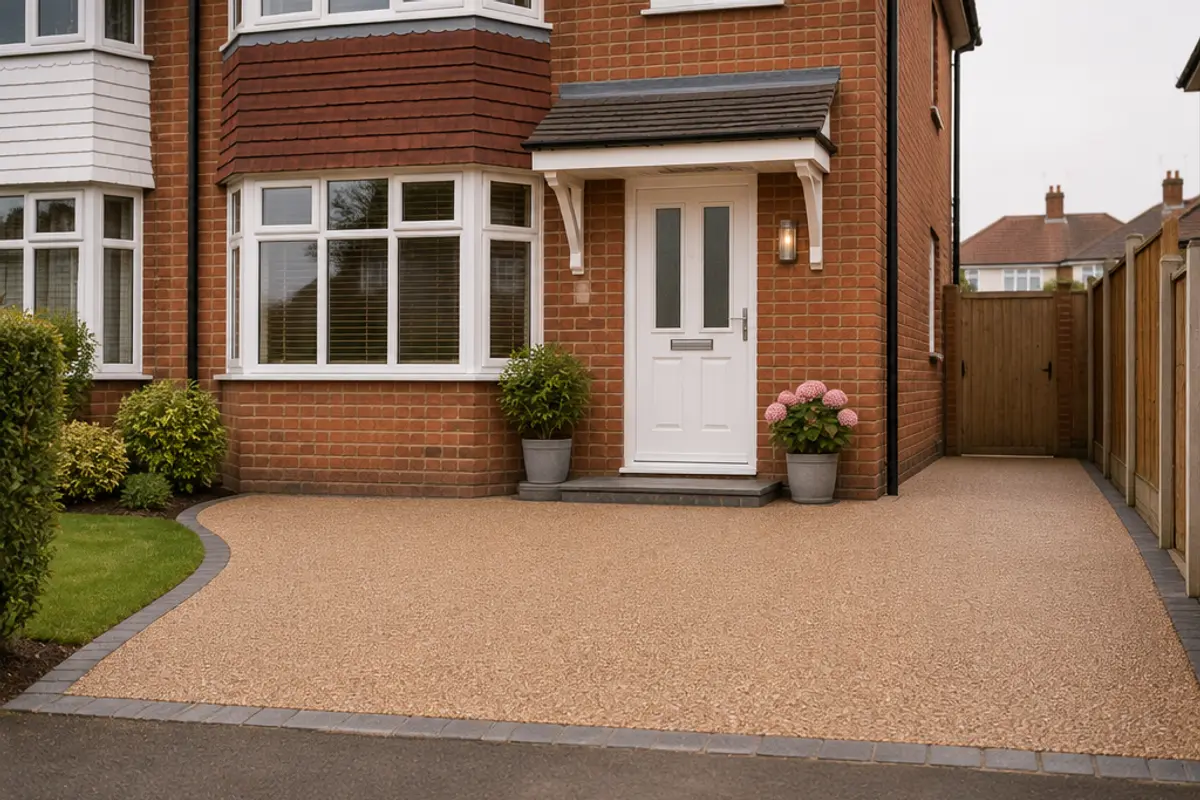
How to use the driveway cost calculator
- Choose your Driveway surface: resin-bound, block paving, tarmac, gravel, plain concrete or imprinted concrete.
- Give the size as Length × width or as a Total area. A single-car drive is about 3 m wide, and two cars side by side need about 5 m.
- Tick Remove an existing driveway first if the old surface has to come up, and Ground needs levelling or grading if the ground slopes or is uneven.
- Tick Dropped kerb needed if the drive crosses a pavement or verge to the road. This adds the building work and the council's fee.
- Pick your region under Where do you live? so prices are adjusted for London, the South East, the North, Scotland, Wales or Northern Ireland.
- Tap Add to shopping list to keep the result, or Share link to send it to the people quoting for the job.
Why use this calculator
It covers resin-bound driveways properly. Resin is one of the most searched-for driveway surfaces, and it sits next to block paving, tarmac, gravel and concrete so you can compare like with like.
The prices already include digging out and the sub-base, which is where many driveway quotes get confusing. You enter your own size and see a range for your own job, not a fixed table for a 50 m² example.
It treats the one-off extras separately. Removing the old drive, levelling the ground and a dropped kerb are priced as jobs, not per square metre, and the council's fee is not adjusted for region because the council sets it.
How we worked it out
Your numbers, step by step. This updates as you change the calculator.
- Area = length × width = 6 m × 4 m = 24 m²
- Using UK average prices, so no regional adjustment.
- Resin-bound, installed: 24 m² × £60 – £150 per m² = £1,450 – £3,600 (typical £2,300). This includes digging out and the sub-base (for a concrete drive, one guide puts the sub-base alone at £15 – £25 per m²).
- Total = £1,450 – £3,600 (typical £2,300)
How we estimate the cost
We take the price range for your surface from published UK cost guides: a low, a typical and a high figure per square metre. These are installed prices. They include digging out and the sub-base (the compacted stone layer under the surface), which one price guide puts at about £15 to £25 per m² for a concrete drive (resin needs a more carefully built base, so it can be more).
- Area: length × width, or the total area you type in.
- Surface cost: area × the per-m² price, for low, typical and high.
- Extras: removing an old drive, levelling the ground and a dropped kerb are added as one-off jobs.
- Region: every price except the council fee is multiplied by a regional factor. London is 1.25, the South East 1.15, the North 0.92, Scotland 0.93, Wales 0.92 and Northern Ireland 0.88. These are our own estimates, not an official index.
- Total: the lows added together, the typical figures added together and the highs added together. You see the low to high range, plus the typical cost.
The calculator also shows the same area in the other surfaces at their typical price, for the surface alone, so you can compare.
What’s included
Per square metre, installed, UK average:
| Surface | Low | Typical | High |
|---|---|---|---|
| Resin-bound | £60 | £95 | £150 |
| Block paving | £90 | £125 | £175 |
| Tarmac | £50 | £70 | £100 |
| Gravel | £40 | £55 | £100 |
| Plain concrete | £50 | £90 | £130 |
| Imprinted concrete | £100 | £115 | £130 |
Optional one-off jobs, before any regional adjustment:
- Removing the old driveway: £500 to £2,000, typically £1,000.
- Levelling and grading the ground: £750 to £1,500, typically £1,100.
- Dropped kerb, building work: £750 to £3,000, typically £2,000.
- Dropped kerb, council fee: £125 to £500, typically £300. The council sets this, so we do not adjust it for region.
Not included: extra drainage, lighting, VAT where a firm adds it, and any planning application. Ask each firm what its quote covers.
What changes the price
- Surface. Gravel and tarmac are usually cheaper. Block paving and resin-bound cost more.
- Size. The bigger the area, the more it costs. Measure carefully.
- Access and digging out. Tight access, a lot of soil to remove, or a deep sub-base for heavy vehicles all add cost.
- Slope and drainage. Sloping ground needs levelling, and water has to go somewhere.
- The old drive. Taking it up and getting rid of it is a separate cost.
- Dropped kerb. You need the council’s permission first, and fees differ a lot between councils.
- Where you live. Labour costs more in London and the South East than in the North.
- Price guides disagree. For some surfaces, such as gravel and imprinted concrete, we found few sources, so those ranges are rougher. The calculator warns you when this applies.
Tips
- Get at least three quotes and ask each firm what is included: digging out, depth of sub-base, drainage, edging and taking away the spoil. Drop the numbers into the quote checker to see how they compare with typical UK prices.
- Ask the council about a dropped kerb before you book any work. You need its permission first, and fees differ from council to council.
- Check whether your drive needs planning permission or a particular type of surface. This depends on your house and your council, so use the planning permission checker as a starting point, then ask your council.
- Measure properly. Use the square metre calculator for odd shapes, because a few extra square metres changes the price noticeably.
- If you are doing the base yourself, work out the stone with the gravel calculator and any concrete with the concrete calculator.
 Gravel calculator
 Block paving calculator
 Concrete calculator
 Square metre calculator
 Quote checker
 Planning permission checker