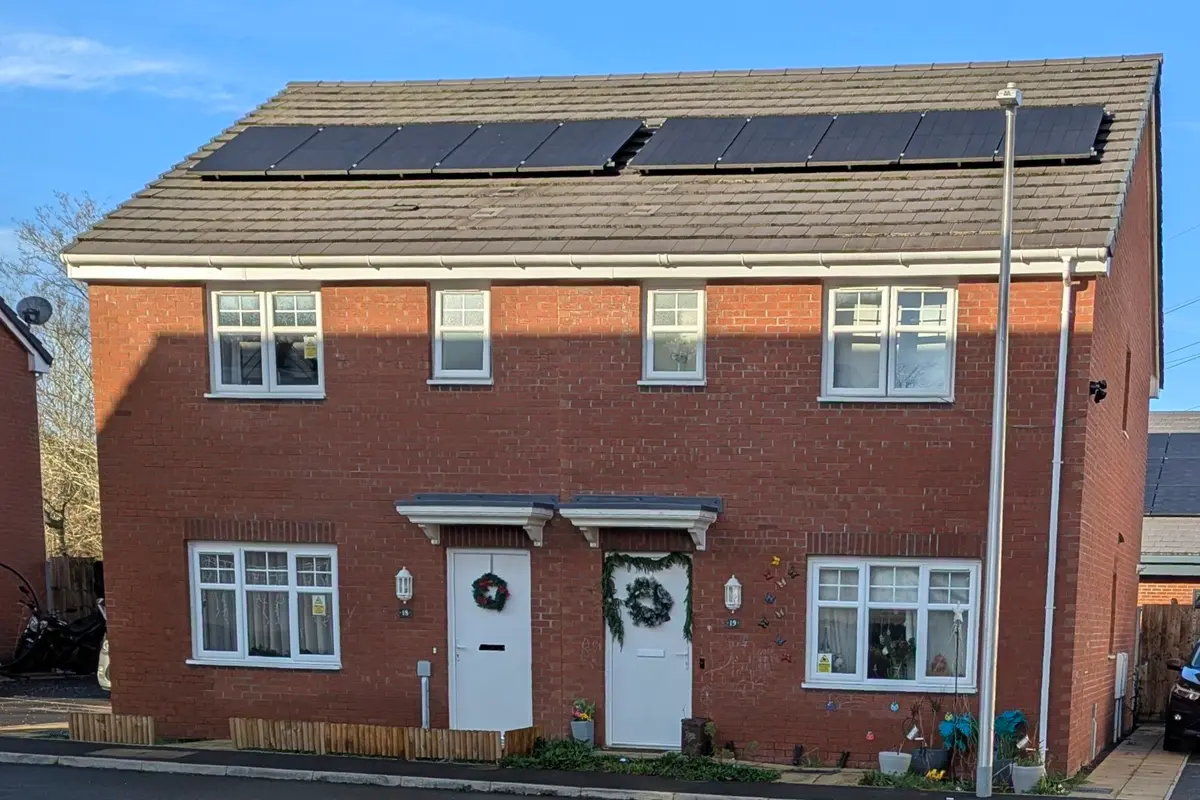
How to use the solar panel calculator
- Choose Size the system by: My electricity use or My roof space.
- For electricity use, type Electricity you use in a year from your bill or app, and the Share of that to generate. 100% means the panels make as much as you use. For roof space, type the Roof space for panels, the clear area facing the sun.
- Pick Where are you?, Which way does the roof face? and Roof pitch. Most pitched roofs are 30° to 40°.
- Add Loss from shade (0 if there is none) and Panel power. Most new panels are 400 W to 450 W.
- Read the Number of panels, System size, Roof area needed and Electricity generated each year, then tap Share link to send it to an installer.
Why use this calculator
It is about generation only. It tells you how much electricity the panels should make. It doesn't promise savings, because those depend on how much of it you use at home and what you are paid for the rest.
It needs no postcode. Pick a region from a list, or use the cautious UK average, and the result is the same every time.
It uses real sun data. The yield figures and the effect of roof direction and pitch come from the EU's PVGIS tool, not from a single rule of thumb. The notes below explain where they come from.
It shows its working. You can see the yield per kWp, how direction and shade change it, and every step to the panels and kWh, so you can check an installer's quote against it.
How we worked it out
Your numbers, step by step. This updates as you change the calculator.
- Yield for a south-facing roof at 35° in the UK (cautious average): 900 kWh per kWp per year.
- Roof facing south at 35° gives 100% of that, and shade takes off 0%: 900 × 1 × 1 = 900 kWh per kWp per year.
- To generate 2,500 kWh a year you need 2,500 ÷ 900 = 2.78 kWp.
- Panels: 2.78 kWp × 1,000 ÷ 430 W = 6.46, rounded up to 7 panels.
- System size = 7 panels × 430 W = 3.01 kWp.
- Roof area needed = 3.01 kWp × 5.5 m² per kWp = about 16.6 m² (the panels themselves cover about 13.7 m²).
- Yearly generation = 3.01 kWp × 900 kWh per kWp = 2,709 kWh.
- Share of your 2,500 kWh use = 2,709 ÷ 2,500 = 108%.
The formula
- Yield per kWp = the base yield for your region × the direction and pitch factor × (1 − shade).
- From your electricity use: kWp needed = yearly kWh to generate ÷ yield per kWp. Panels = kWp × 1,000 ÷ panel watts, rounded up.
- From your roof space: kWp that fits = roof area ÷ 5.5 m² per kWp. Panels = kWp × 1,000 ÷ panel watts, rounded down to whole panels.
- System size = panels × panel watts ÷ 1,000.
- Yearly generation = system size × yield per kWp.
A kWp (kilowatt peak) is the output of the panels in ideal test conditions. A 430 W panel is 0.43 kWp.
Where the yield figures come from
- Base yield: 900 kWh per kWp per year is our cautious UK figure for a south-facing roof at about 35° with no shade. It’s lower than the sun data for most of the UK, on purpose.
- By region: the city figures come from PVGIS, the EU Joint Research Centre’s free solar tool (version 5.3, using satellite radiation data, assuming 14% system losses). We then work out an MCS-style figure from the PVGIS sunlight data, taking 0.8 of the yearly sunlight on the panels, as the MCS standard (MIS 3002) does. These run from 796 kWh per kWp (Inverness) to 1,094 (Plymouth). They are not official MCS figures, and an MCS installer’s number for your roof can differ by about 5% to 10%.
- Direction and pitch: we use PVGIS runs for London, Manchester and Glasgow and average them. At a 35° pitch a south roof gives 100%, south-east 95%, south-west 94%, east 80%, west 79% and north 55%. A flat roof gives 83%.
- As a check: Which? says a typical 4 kWp home system can generate more than 3,000 kWh a year, which fits with the figures here.
What we assume
- Panel size: 430 W by default, which is about 1,722 × 1,134 mm (1.95 m²). You can change the watts.
- Roof area: 5.5 m² per kWp. This includes gaps between panels and about 0.3 to 0.4 m clear of the ridge and edges, as installers commonly leave. It’s a planning figure.
- Typical use: 2,500 kWh of electricity a year for a typical UK home, the Ofgem typical-household figure, and a typical home system of about 4 kWp.
- Shade: the figure you enter is taken straight off the yield. Use your installer’s survey if you have one.
- Generation, not savings: the share of your use we show is a yearly total. You will not use it all as it is made.
Tips
- Use the figure on your bill or app for Electricity you use in a year. About 2,500 kWh is a typical UK home, but yours may be very different.
- Don't size the system to cover 100% unless you will be home in the day. You only use electricity as it is made, so you will still buy power at night and in winter. A battery or a daytime routine raises how much you use yourself.
- Treat the result as a starting point. An MCS installer's survey gives the figure for your actual roof and shade.
- A roof facing east or west still works. At a typical 35° pitch it makes about 80% of a south roof. A north roof makes about 55%, so look at other roofs first.
- Check your cost and payback separately. The energy upgrade payback tool is the place for money, and the energy bill calculator shows what you pay now.
 Energy bill calculator
 Energy upgrade payback
 Heat pump cost calculator
 Roof pitch calculator
 Insulation calculator
 Quote checker
