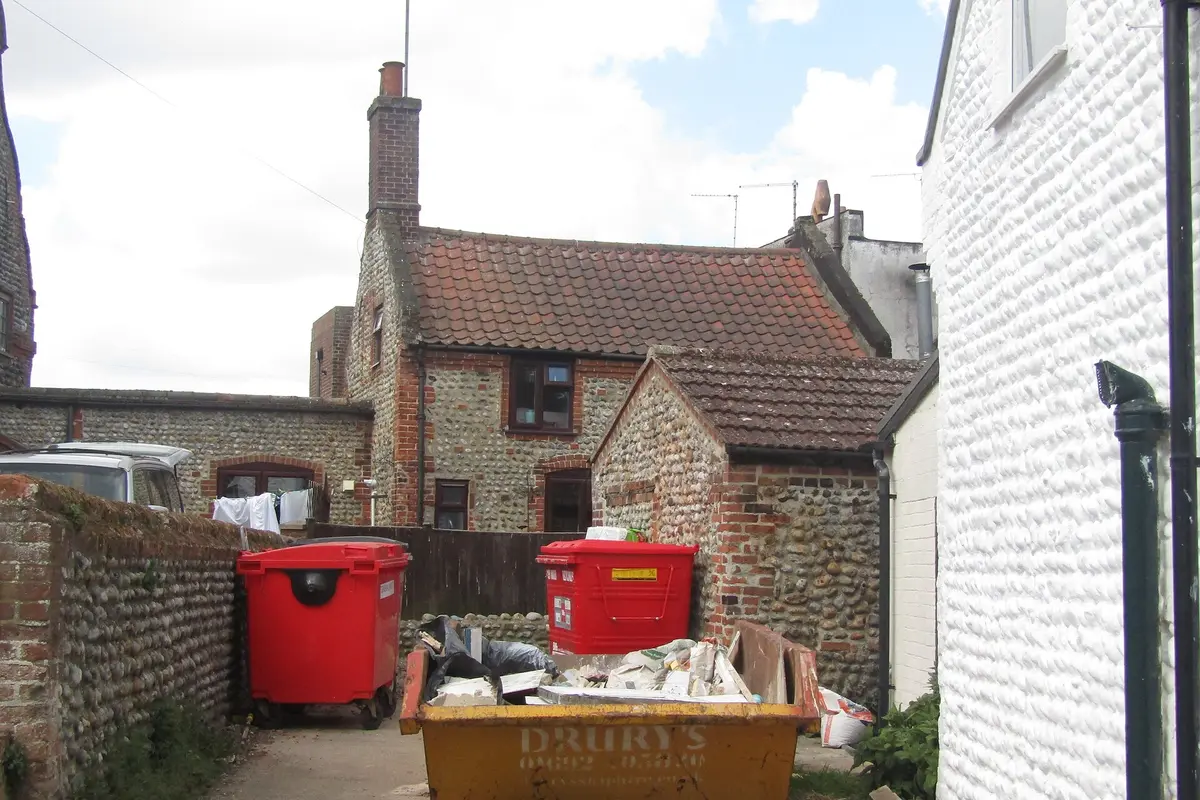
How to use the skip size calculator
- Enter the Bin bags of waste. Use standard black sacks of about 100 litres each.
- Add any Other loose waste (furniture, timber, plasterboard) if you can estimate it in cubic metres. Leave it at 0 if not.
- Add Rubble, brick or hardcore and Soil or turf in m³, yd³ or litres. These are heavy, so they are counted separately.
- Leave Extra room for awkward shapes at 10%. Bulky items leave gaps.
- Read the smallest skip that fits, then check the weight warning and the next size up. Tap Add to shopping list or Share link to send it to a skip firm.
Why use this calculator
It keys off cubic yards, not names. Skip firms call the same size by different names. One firm's "builders" skip is a 6 yard and another's is an 8 yard. The calculator gives a size in yards and m³, which every firm uses.
It treats heavy waste differently. Rubble and soil pack tight, so they get no extra room, and the calculator estimates the weight, because a skip is often overweight long before it is full.
It shows the bin bag view as well as the cubic view, so you can picture what fits.
It does not push you to a firm or a size. It tells you the smallest skip that fits and what the next size up would give you.
How we worked it out
Your numbers, step by step. This updates as you change the calculator.
- Bin bags: 30 bags ÷ 8 bags per cubic yard × 0.7646 m³ per cubic yard = 2.87 m³
- Add 10% room for awkward shapes to the light waste: 2.87 m³ × 1.1 = 3.15 m³
- Total volume = 3.15 m³
- The smallest skip with room for 3.15 m³ is a 6 yard skip (4.6 m³).
The formula
The calculator turns everything into m³ and finds the smallest skip that has room for it.
Total volume = bin bags + loose waste, plus the extra room, plus rubble and soil
- Bin bags: bags ÷ 8 bags per cubic yard × 0.7646 m³ per cubic yard. 30 bags is 30 ÷ 8 × 0.7646 = 2.87 m³.
- Loose waste: the m³ you enter, added to the bags.
- Extra room: your percentage is added to the bags and loose waste only. 2.87 m³ plus 10% is 3.15 m³.
- Rubble and soil: added at their exact volume, with no extra room.
- Weight of heavy waste: rubble m³ × 1.6 + soil m³ × 1.5, in tonnes.
The skip sizes are compared with the total. For 3.15 m³ the answer is a 6 yard skip, because a 4 yard skip holds only about 3.06 m³.
What we assume
- Skip sizes by cubic yard: 2 yard (1.5 m³), 4 yard (3.1 m³), 6 yard (4.6 m³), 8 yard (6.1 m³), 10 yard (7.6 m³), 12 yard (9.2 m³), 14 yard (10.7 m³) and 16 yard (12.2 m³). The calculator works each capacity out as cubic yards × 0.7646, so a 4 yard skip is 3.06 m³, where some firms quote 3.0 m³. Some firms list their sizes a little differently, and names such as mini, midi, builders and maxi vary between firms.
- Bin bags: 8 black sacks per cubic yard is a mid-point planning figure. Firms disagree by up to about 25%, and the numbers they quote for each skip size overlap, so treat this as a guide.
- Rubble is taken as 1.6 tonnes per m³ and soil as 1.5. Real weights vary with the material and how wet it is, and dense, well-packed rubble can be nearer 2 tonnes per m³, so treat the weight as a minimum.
- Weight limits depend on the firm. We quote about 6 to 8 tonnes for a 6 yard skip as a common range.
- A skip on a public road needs a permit from the highway authority (Highways Act 1980, section 139). The skip firm normally applies for it. Fees differ between councils.
Tips
- Fill a skip level. Waste must not stick up above the sides, so break long pieces down and keep bulky items from standing proud.
- Ask your skip firm for its weight limit. For a 6 yard skip it is often about 6 to 8 tonnes, and heavy waste such as soil and rubble is usually put in a smaller skip.
- Tell the firm what is going in the skip. Heavy waste such as soil and rubble can change which skip they send.
- If your waste only just fits, think about going up a size. The calculator shows the next size up when your waste fills more than 90% of the skip.
- If the skip will sit on the road, ask the firm whether it arranges the permit. If you know the weight of your soil or rubble in tonnes, the tonnes to m³ converter turns it into a volume.
 Tonnes to m³ converter
 Cubic metre calculator
 Driveway cost calculator
 Concrete calculator
 Kitchen cost calculator
 Project shopping list
