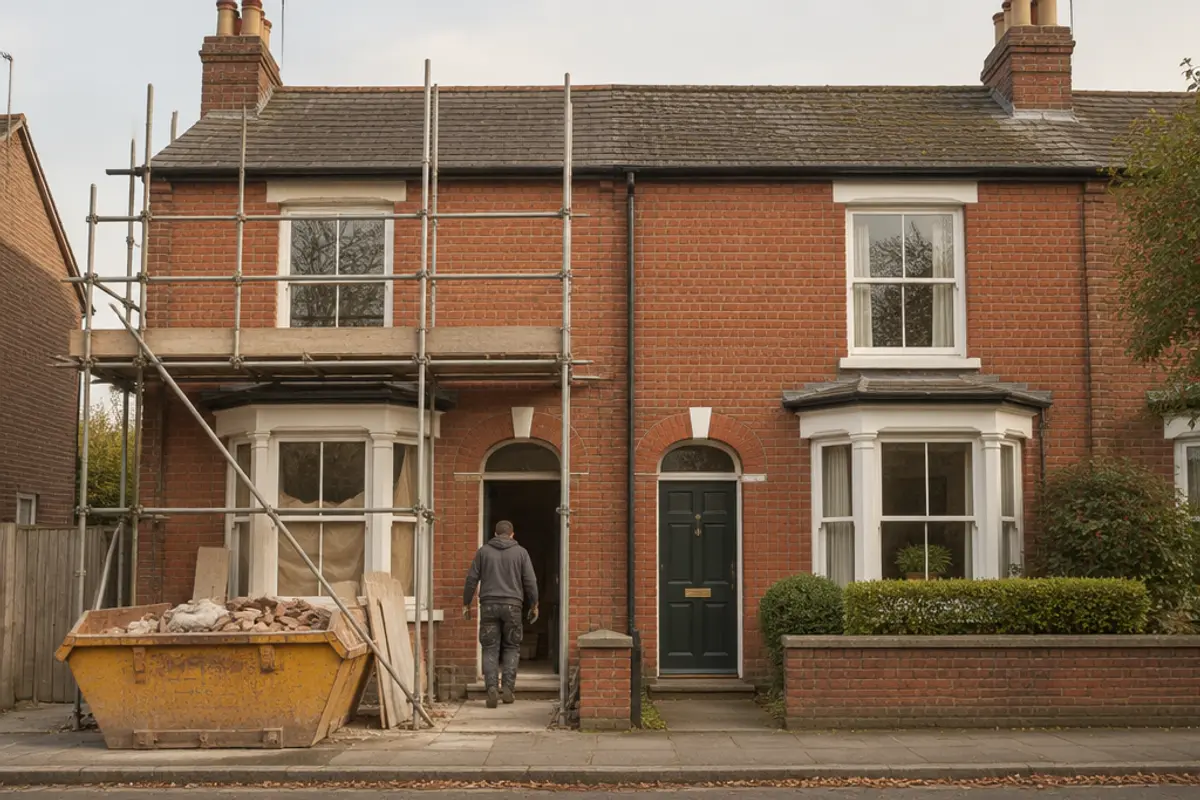
How to use the party wall notice generator
- Under What work are you planning? choose the closest match: a new wall on the boundary, a new wall wholly on your own land, work to an existing party wall, or digging near the neighbour's building.
- For digging, enter How far is the work from the neighbour's building? and How deep will your excavation or foundations go? If you don't know their depth, tick I don't know how deep the neighbour's foundations are.
- Enter How many adjoining owners are affected? Each owner gets their own notice. Count freeholders and long leaseholders (over a year), not only the person next door.
- If you chose party wall work or digging, say whether the neighbour will agree to the work in writing. If every neighbour agrees, no surveyor is needed.
- Read the notice name, the section of the Act, the minimum notice and the example letter. Tap Copy result to keep the answer, or Share link to send it to your builder.
Why use this calculator
It picks the notice for you. The Act has three kinds of notice and the right one depends on the work. You answer a few plain questions, and it names the notice and the section of the Act.
It checks the digging rules with your numbers. The 3 metre and 6 metre rules depend on distance and depth, so it works them out and shows the working.
It gives you a cost estimate for surveyors, and tells you when there is nothing to pay: if your neighbour agrees in writing, there is no dispute and no surveyor.
It points to the official letters. Instead of a template of our own, it links to the GOV.UK example letters and the explanatory booklet, so you use wording the Government has published.
How we worked it out
Your numbers, step by step. This updates as you change the calculator.
- Work to an existing party wall, such as cutting into it to take the bearing of a beam or raising its height, needs a party structure notice under section 3. Serve it at least 2 months before the work starts.
- Serve 1 notice, one for each adjoining owner, saying what you plan to do and when it starts.
- Each owner has 14 days to reply. If they agree in writing, the work can go ahead with no surveyor. If they dissent, or say nothing within 14 days, a dispute is deemed to have arisen.
- To settle a dispute, you and your neighbour agree one surveyor, or each appoint your own (they pick a third if they cannot agree). You cannot act as your own surveyor.
- If a neighbour does not appoint a surveyor within 10 days of your request, you can appoint one on their behalf (section 10(4)).
- The surveyor or surveyors make a party wall award saying what work, how and when. You usually pay the surveyors' fees when the work is for your benefit.
- Start only after the notice period has passed (and any award is made). A notice lapses if you have not started within 12 months.
- Result: Party structure notice, at least 2 months before you start.
The three notices
- Line of junction notice (section 1). For a new wall on the boundary. Serve it at least 1 month before you start. If the new wall is astride the boundary and your neighbour doesn’t consent within 14 days, you can only build wholly on your own land. GOV.UK example letter 4 is for a wall astride the boundary, and letter 6 is for a wall wholly on your own land.
- Party structure notice (sections 2 and 3). For work to an existing party wall, such as cutting into it to take the bearing of a beam, or raising its height. Serve it at least 2 months before you start. GOV.UK example letter 1 is for this.
- Notice of adjacent excavation (section 6), the “3 metre or 6 metre notice”. Serve it at least 1 month before you dig. GOV.UK example letter 8 is for this.
You can find all the example letters on the GOV.UK party wall guidance page. The explanatory booklet explains the Act in plain language.
How we pick the notice
The calculator chooses the notice from the work you describe. For digging, it uses two tests from section 6. A notice is needed if either is true:
- The 3 metre test. Your excavation is within 3 m of the neighbour’s building and goes deeper than the bottom of their foundations.
- The 6 metre test. Your excavation is within 6 m and cuts through a line sloping down at 45 degrees from the bottom of their foundations. The line drops 1 m for every metre you are away from them.
If you don’t know how deep their foundations are, we say a notice is the safe choice. A surveyor or a trial hole will tell you the depth.
What we assume
- The notice period is the minimum before work starts: 1 month, or 2 months for a party structure notice.
- Your neighbour has 14 days to respond. If they consent in writing, there is no dispute and no surveyor needs to be appointed.
- If a dispute arises, you and your neighbour either agree one surveyor or each appoint your own. They make an award saying what work, how and when. The person doing the building work usually pays.
- Surveyor fees are £700 to £2,000 per adjoining owner, typically £1,000. They roughly double if you each have your own surveyor. These are estimates from published UK cost guides, so get at least three quotes.
- A notice lapses 12 months after it is served if the work hasn’t started.
- We don’t write notices. Use the GOV.UK example letters or a party wall surveyor.
Tips
- Talk to your neighbour before you serve anything. If they agree in writing, you can skip the surveyors. The notice is a formal step, and a friendly chat first usually goes better.
- Serve one notice per adjoining owner. A notice lapses if you haven't started within 12 months.
- Small jobs may not need a notice. GOV.UK says drilling for shelves or wall units, putting in recessed sockets, or removing and replastering is too minor.
- A party wall notice is separate from planning permission and building regulations. Check the planning side with our planning permission checker, which uses the national rules for houses in England. Your council has the final say.
- Put the fees in your budget. See the planning permission cost estimator and the house extension cost calculator for surveyor fees alongside the other costs.
- Not sure which notice applies, or your neighbour disputes it? Ask a party wall surveyor. This page is a guide, not legal advice.
 Planning permission checker
 Planning permission cost estimator
 House extension cost calculator
 Loft conversion cost calculator
 Quote checker