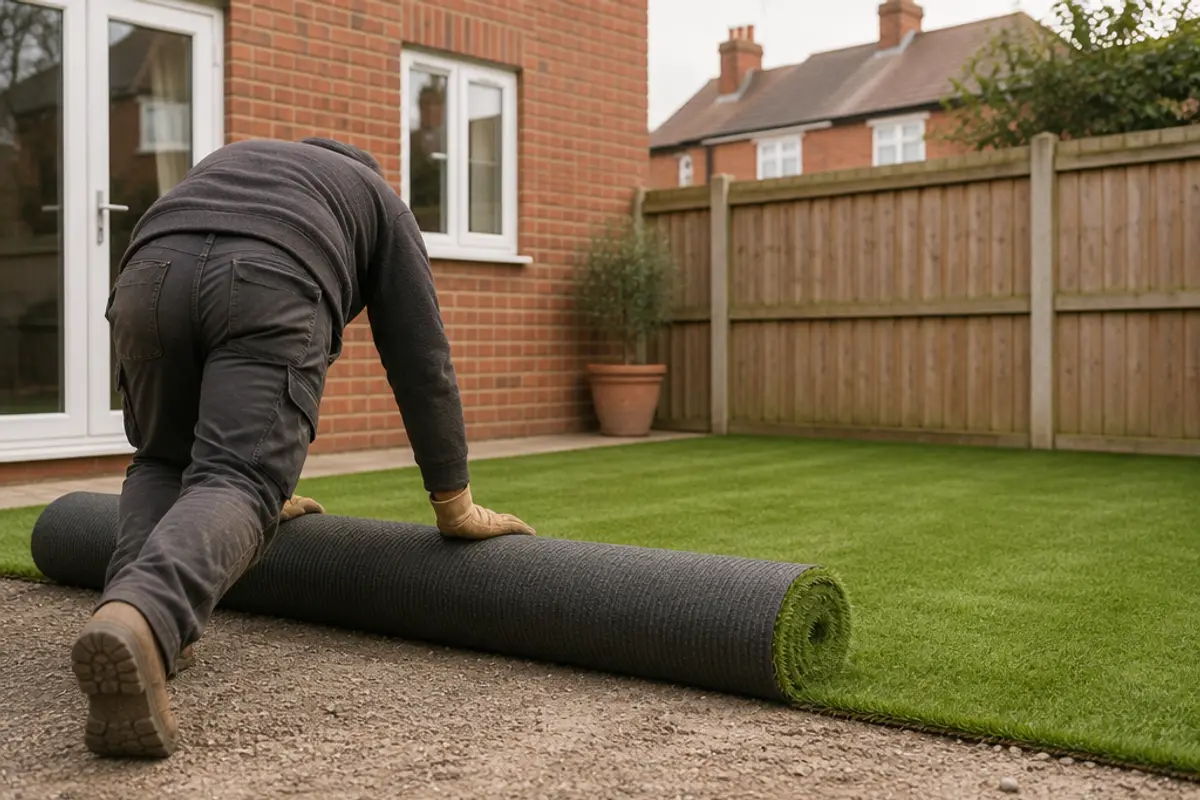
How to use the artificial grass calculator
- Enter the Lawn length and Lawn width. Each box has its own unit, so you can use metres or feet.
- Leave Work out the sub-base switched on to get the MOT Type 1 and the sharp sand or granite dust layer.
- Switch on Add sand infill if your grass needs it. Skip it if you have pets that use the lawn.
- Read the Grass to buy result. It shows the roll width, the length to order and which way the strips run.
- Compare the 2 m and 4 m results to see the trade-off between spare grass and joins.
- Tap Add to shopping list to keep the result or Share link to send it to your supplier.
Why use this calculator
It does the joins versus waste trade-off for you. A narrower roll can use less grass but leaves more joins, which show in a lawn. The calculator picks the layout with the fewest joins unless that means buying more than 20% of the lawn area in extra grass.
It tries every layout. It works out 2 m and 4 m rolls, with the strips along the length and along the width, and shows you the numbers for each.
It adds the ground work. You get the MOT Type 1 sub-base, the sharp sand levelling layer and the infill in the same result.
It shows its working. Under How we worked it out you can see every layout it tried.
How we worked it out
Your numbers, step by step. This updates as you change the calculator.
- Lawn area = 6 m × 3.5 m = 21 m²
- 2 m roll, strips along the length: 2 strips, roll length 12 m, 24 m² bought (3 m² spare), 1 join
- 2 m roll, strips along the width: 3 strips, roll length 10.5 m, 21 m² bought (0 m² spare), 2 joins
- 4 m roll, strips along the length: 1 strip, roll length 6 m, 24 m² bought (3 m² spare), 0 joins
- 4 m roll, strips along the width: 2 strips, roll length 7 m, 28 m² bought (7 m² spare), 1 join
- Best layout (fewest joins, unless that wastes more than 20% extra grass): 4 m wide roll, 6 m long, strips along the length.
- MOT Type 1 = 21 m² × 75 mm × about 2.1 t/m³ × 1.1 allowance = 3.64 tonnes (5 bulk bags)
- Sharp sand or granite dust = 21 m² × 25 mm × about 1.7 t/m³ = 0.89 tonnes (2 bulk bags)
The formula
Grass comes on rolls of a fixed width and is cut to length. Strips are laid side by side, so the number of strips is the width you need to cover divided by the roll width, rounded up.
Strips = distance across ÷ roll width, rounded up Roll length = strips × length of each strip Joins = strips − 1
For a 6 m by 3.5 m lawn (21 m²), the calculator tries four layouts:
- 2 m roll, strips along the 6 m length: 2 strips, 12 m of roll, 24 m² bought, 1 join.
- 2 m roll, strips along the 3.5 m width: 3 strips, 10.5 m of roll, 21 m² bought, 2 joins.
- 4 m roll, strips along the 6 m length: 1 strip, 6 m of roll, 24 m² bought, no joins.
- 4 m roll, strips along the 3.5 m width: 2 strips, 7 m of roll, 28 m² bought, 1 join.
Joins show in a lawn, so the best layout is the one with the fewest joins, unless that means buying more than 20% of the lawn area in extra grass. Here that is the 4 m roll, 6 m long. Joining tape is the length of each join added up.
For the ground work:
- MOT Type 1 = area × 0.075 m × about 2.1 tonnes per m³ × 1.10. For 21 m²: 3.64 tonnes, or 5 bulk bags of 850 kg.
- Sharp sand or granite dust = area × 0.025 m × about 1.7 tonnes per m³. For 21 m²: 0.89 tonnes, or 2 bulk bags.
- Sand infill = area × 5 kg. For 21 m²: 105 kg.
What we assume
- Rolls are 2 m or 4 m wide and up to 25 m long. Some sellers also offer 5 m. We have not confirmed these widths with a manufacturer datasheet, so check your supplier’s range.
- The sub-base is 75 mm of MOT Type 1, as Wickes suggests for clay or poor drainage. Other guides give different depths, so check the ground on your site and ask your installer.
- The levelling layer is 25 mm of sharp sand. Wickes gives 20 to 40 mm, and other guides differ, so 25 mm is a middle-of-the-road choice. Granite dust is about the same weight.
- Sand infill is about 5 kg per m², from Wickes, which also says sand is not advisable for pet owners. Not every grass needs infill, and pets change the answer.
- MOT Type 1 is about 2.1 tonnes per m³ once compacted, with 10% added for compaction.
Tips
- Look at the pile direction. The pile should lean towards where you will look at the lawn from, and all strips must lie the same way.
- Suppliers cut rolls to length in set steps. Ask what your supplier rounds to, and leave a little to trim at the edges.
- Ask whether your grass needs infill. The infill type depends on the grass and on whether pets use the lawn, so ask the maker, and do not use sand infill if you have pets.
- Keep the offcuts. The spare grass from the best layout is useful for patching a worn spot later.
- Work out the area of an awkward lawn first with the square metre calculator, then use the nearest rectangle here and add a little for the shape.
- The base is the same job as a path or patio. The gravel calculator has MOT Type 1 if you want to check the stone on its own.
 Square metre calculator
 Turf calculator
 Gravel calculator
 Block paving calculator
 Topsoil calculator
 Project shopping list